
As part of my 2-part project on the Fed Model, I want to give you the results of my recent investigation. This is the simpler of the two projects. A little while ago, Bespoke Investment Group published two little pieces on the relationship between the yield curve and the absolute level of the S&P 500 over short time periods. (You can see my comments below what they wrote.)
My data went from April 1954 to the present on a monthly basis. I regressed the yields on the three and ten-year treasuries, and a triple-B corporate bond spread series on twelve month trailing earnings yields for the S&P 500. The regression as a whole is highly statistically significant. Except for the t-statistic on the 10-year Treasury yield, the other regressors have t-statistics that are significant at a 95% level. I only did two passes on the data, because I didn’t realize until later that I had the spread series… in the first pass that did not have the spread series, the ten-year yield was significant.
Anyway, here are the statistics. What this says is that in the past trailing earnings yields tended to:
- decline when BBB spreads rose
- rise when three-year treasury yields rose
- rise when parallel shifts of the yield curve up
- rise when the yield curve flattens, with no adjustment in the overall height of the curve
The last three observations make sense, while the first one does not, at least not on first blush. Typically, I associate higher credit spreads with higher E/Ps, and thus lower P/Es, because tighter financing is associated with a lower willingness for equity investments to receive high valuations. I’m not sure what to do with that last observation; perhaps it is that my practical experience exists over the last 20 years which have been different than the whole data sample. Or, perhaps my readers will have a few ideas? 🙂
As for the main current upshot from this admittedly limited model is that current trailing E/Ps, and thus P/Es, are fairly valued against current treasury yields and bond spreads. Here are two graphs that illustrate this:
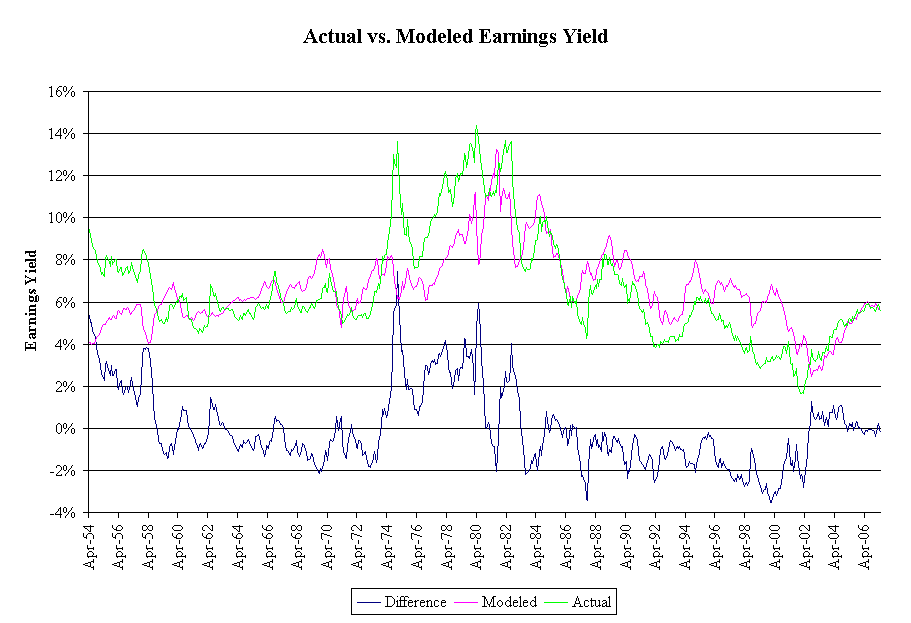

The nice thing about these graphs is that they easily point out the stock market undervaluation relative to bonds in 1954, 1958, 1962, 1974, 1980, 1982, and September 2002, and overvaluation relative to bonds in 1969, early 1973, 1987, and March 2000 and March 2002. Now this model might have suggested staying in bonds for most of the 90s, but the 90s were a relatively good decade to be in bonds, though not as good as equities.
This is the first time I have done a post like this, and so I put it out for your consideration. Comments?
David,
I agree, the results are pretty much as expected, except for the first result. However, I would argue that perhaps the first factor contains additional information about corporate earnings growth, and hence explains the unexpected result. In other words, when corporations are doing well there is higher demand for funds, and BBB spreads rise; the improved corporate earnings growth prospects are more highly valued by the market and P/E’s rise. Nowadays, of course improved corporate health results in lower spreads, due to the highly liquid high yield and corporate bond markets; I wonder whether perhaps the regression coefficient would differ if analyzed pre-Milken and post-Milken, say from 1954-1980, and 1981 to present.
Anyways, interesting study.
The first result is as expected, maybe not intuitive at first glance.
At the end of expansion cycle earnings, stock price and short term interest rate start to fall but stock prices fall more quickly than earnings becuase market is expecting the beggining of a low growth period. At the same time is highly likely that credit risk would be increasing because the credit market would be contracting thank to monetary tightening that led to end of the expansion cylce.
I thank you both. I appreciate the quality of responses that I receive here… your answers make sense, and I might try splitting the regression as you suggested, Steve.