
My preferred monetary policy in normal times is for the yield curve to have about 50 basis of positive slope from twos to tens. That’s enough slope for the economy to grow, and the banks to make a little money, but not lend aggressively. It’s flat enough to restrain inflation as well. Sounds good, but it would require discipline on the part of the central bankers to stick to it, because of political pressures to goose growth, or banks complaining that they can’t earn enough.
These aren’t normal times, though. Let me explain two ways that it is abnormal. First, the Two-year Treasury, which is a good measure of what the market expects Fed funds to be in 6-12 months, is about 1% lower than the current Fed funds rate. Second, the short-term private lending markets have not followed the 3-month T-bill yield lower. The one that I have looked at most closely recently is the Treasury-Eurodollar Spread [TED Spread], which is the difference between the 3-month LIBOR yield, and the yield on a 3-month T-bill. It closed out yesterday at a spread of 2.04%. Anything over 0.60% indicates stress in the short-term lending markets.
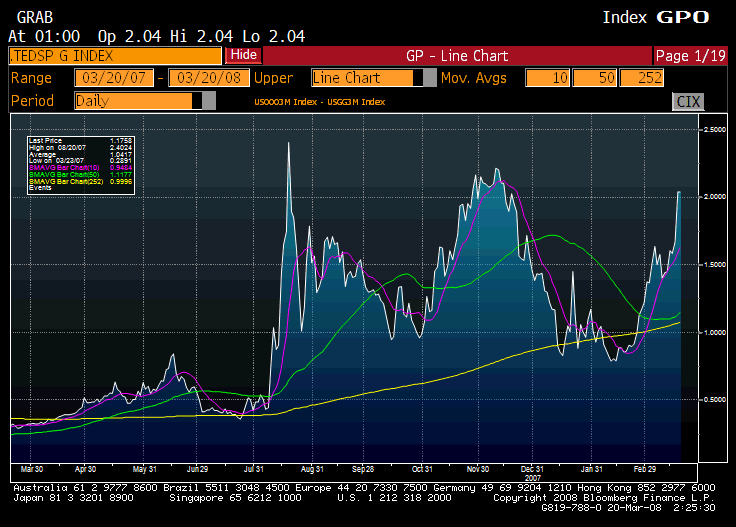
Not so good, huh? Will the Fed try to boost the size of the TAF again to fight this? (Hey, is that a head-and-shoulders pattern? 😉 ) Now we can look at the Treasury yield curve:
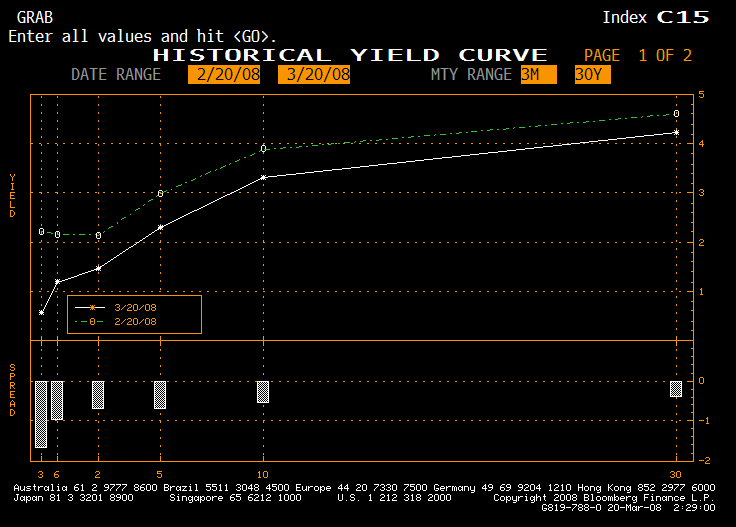
Well, at least the curve is positively sloped over all of its major segments now. That is a positive, right? 😉 Well, in a situation where the economy is growing, it would be normal, and good for lenders. When it is because of a money market flight to safety, that’s another matter, and not a positive, at least not yet.
That brings me to my second point. The lowest prime grade of Commercial Paper, A2/P2 CP, has an inordinately high yield compared to safer short term loans when the financial system is under stress. My thought was to create a combination measure that took into account both measures of short term financial stress. Both series come from the Fed’s H.15 report. My measure is subtracting the yield on nonfinancial A2/P2 CP from the two-year Treasury yield.
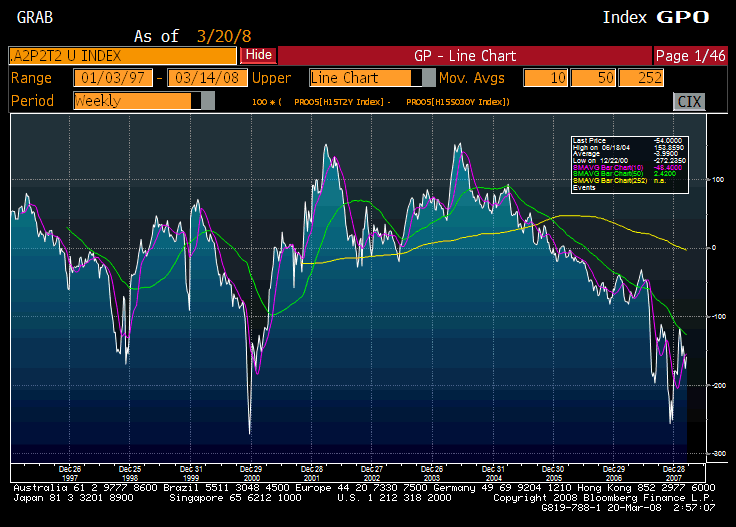
A2/P2 financial paper outyields the Two-year Treasury by 1.60% at present. That’s not as bad as things were in August or December of 2007, but that level eclipses levels reached in the LTCM crisis, but not the monetary tightness overshoot back in December of 2000.
Note that the average level over the eleven-plus years that I was able to get data is very close to zero. The positive periods tend to be long and shallow, like most bull markets. Seemingly also, the measure seem slightly correlated with stock market returns, but I could be wrong there. The negative periods tend to be short and sharp, like most crises. This present period is an exception — we’ve been in the negative zone for two years.
Am I saying the FOMC should loosen aggressively from here? Not necessarily, but I am saying that the financial system is still under significant financial stress, and existing measures like the TAF have not cleared that yet.
The Fed is facing some very hard choices here. I wouldn’t want to pursue a zero interest rate policy here in the US like they have in Japan, with not that much success. But maybe that’s because the Fed is behaving like the Bank of Japan. The Fed has been sterilizing its rate cuts and its unorthodox measures, and not allowing the monetary base to grow, which makes no sense to me in a loosening cycle. (Well, I take that back, it makes perverse sense. They are trying to draw to an inside straight — they are trying to restrain price inflation at the same time they solve problems in the financial system by downgrading their own balance sheet by lending and selling Treasuries. I don’t think it will work.)
Maybe the Fed should buy A2/P2 CP (please no 🙁 )? My view is that they should let the monetary base grow, and do some permanent injections of liquidity. We haven’t had one in 10.5 months, which is really unusual, particularly for a loosening cycle.
Will they do that? My guess is no, not until they have run out of Treasuries to sell or lend.
Update
Go to Alea and look at the repo fails on Treasuries.? Just another sign of system stress.
I think the spread info shows the stress, but it’s made even more apparent if you look at the ratio of the spread, not the absolute – huh?
Let’s say the T2 rate is 4.50 (mid-August); 1.6 spread is .35 ratio
With T2 at 1.46 (yesterday), 1.6 spread is 1.1 ratio
= ~3x the stress, or even higher if one knows more advanced math, which I don’t
What say ye?