
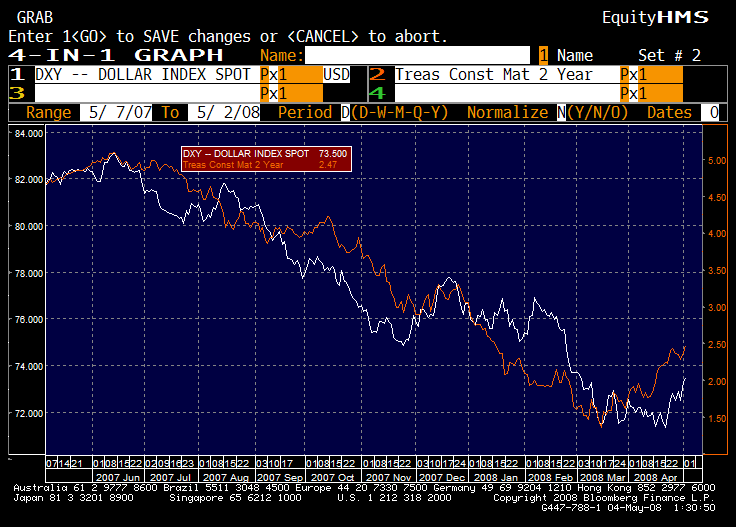
1) Desperation and the Dollar. In mid-March, pessimism over the US economy and monetary policy were so thick that people were considering the old Greenspanian rate of 1% Fed funds as possible. Well, times change, at least for now. The orange line above is the 2-year Treasury yield which gives a fair read on expectations of monetary policy, which bottomed in mid-March. It took the Dollar a little longer to move along, but the present course of dollar is up in the short-term (consider the Euro). That doesn’t address the possibilities of a wider lending problem, or the overly aggressive fiscal policies that will be employed by the next President. (Deficits don’t matter, until they are big enough to matter.)
2) I’ve talked about the US Dollar and the five stages of grieving. I think the G7 got to the second stage, anger, in threatening action recently. I think they get a respite from fear because of the bounce in US monetary expectations. My guess is that they would intervene when the Dollar gets to $1.70/Euro. Neither the threats nor the intervention will have much impact in the long run, though. This will only change when foreigners stop buying our bonds, and start buying our goods and services.
3) Another thing that correlates with the shift in expectations of US monetary policy are yields in long government bonds around the world. Surprise, as the anticipated future financing rates rise, the willingness to try to clip a spread off of long bonds declines.
4) So what could replace the Dollar as the global reserve currency? The Euro, maybe? The Yen and Pound are too small, and everything else is smaller still. The Yuan might be ready in 15 years when their financial markets are developed. It takes a long time for the reserve currency to shift.
5) So, why not the Euro? I’m still a skeptic that the EU will hang together without political union. Also, a strong Euro is testing the monetary union in places where credit markets are weak, and export markets are weakening because the US is getting more competitive with the weak Dollar. That said a persistently weak dollar raises the incentives for other countries to look for a new reserve currency. Leaving aside the potential instability of the EU (unlikely in the short run) the Euro is probably the best alternative.
6) This piece by Felix Salmon helps point out why why Iceland is the canary in the coal mine. They are the smallest economy with a floating currency. It seems like they are successfully defending their currency at present, at the cost of 15% interest rates.
7) Is the UK economy just a miniature version of the US economy?
- Cutting Central Bank lending rates
- Bailout plans for the banks (and here)
- Many homeowners with negative equity, and all of the problems that brings
8 ) Why is Chinese inflation rising? Loose monetary policy, and an undervalued Yuan, at least versus the Dollar. Now, maybe the Chinese will start buying Euro-denominated bonds, and sell more to the EU than they buy. (Note that I am not the only skeptic on the Euro’s survival.)
9) What of the Gulf States? What will they do with all of the dollars that they have? Along with China, their huge depreciating Dollar reserves are fueling inflation. Personally, if I were in their shoes, I would buy US corporations quietly, perhaps through the purchase of ETFs. But the huge accumulation of dollars threatens to create the same “white elephant” development schemes that they experienced in the early 80s, when the socialist Gulf governments had too many Dollars, and too few places to use them.

10) Inflation is rising in the OECD. This is a “sea change” in terms of economics. Policymakers have enjoyed falling inflation rates for so long that perhaps they aren’t ready for the degree of monetary tightening necessary to squeeze out inflation.
11) Development isn’t easy after a point. It reveals shortages, as India is experiencing in semi-skilled and skilled labor. This will eventually work out, but in the short run, it makes infrastructure and construction projects difficult. Bodies aren’t enough; skills are needed, and many better skilled Indians work abroad, where they can make more.
12) A rice cartel? Everything old is new again. I remember in the 1970s when the US talked about a wheat/corn cartel, in response to the new strength of OPEC. Personally, I don’t think it would be effective. Agriculture is too flexible for cartel-like schemes to work in the intermediate-term. But, let them try. It will be interesting to see what happens.