
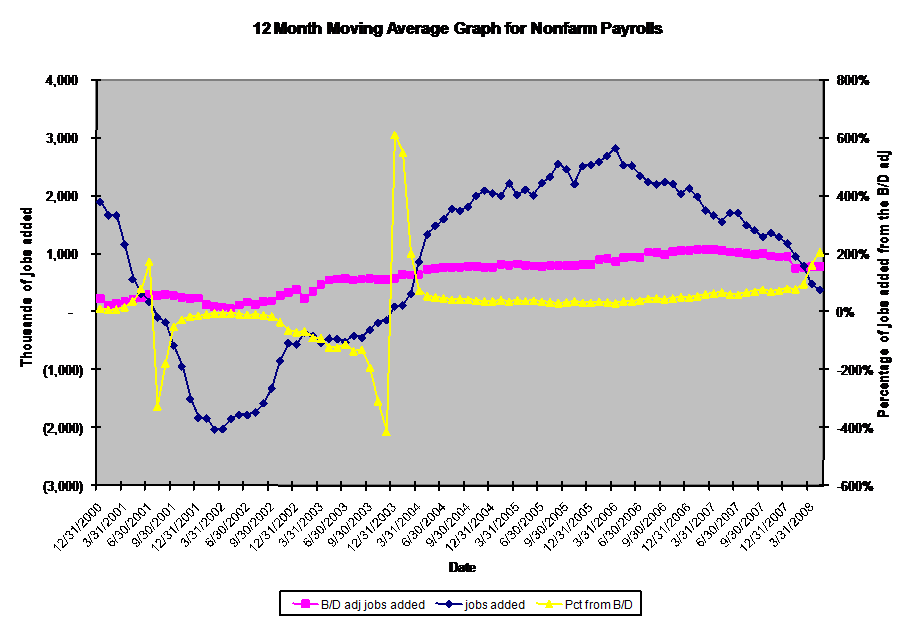
I tried forecasting the non-farm payrolls number when I first came to RealMoney — after all, what other number made as big of a splash? I seemed to do well at it for a while, and then badly, and then I really began to dig in to how the number was calculated. The more I dug into it, the more I concluded that I could not forecast it. Not that it is wrong, made up, whatever. I just could not forecast it, so I gave up.
Not that I like being a quitter, but there are benefits to recognizing reality and respecting it.? I did learn some things along the way, though, and let me explain them:
1) The 12-month change for the seasonally adjusted [SA] and non-seasonally adjusted [NSA] numbers are equal.
2) The seasonal adjustment is more than just an adjustment for seasonality.? There is a distinct annual pattern to the NSA data, and I have done my own seasonal adjustments and they do not reduce that variability nearly as much as the BLS methods which involve ARIMA models.? (As one of my econometrics professors used to say to me, “Practitioners use ARIMA models when they have no idea of what the true model might be.? It’s just a hunt for correlations.”)
In other words, the SA data is not just adjusted for seasonality, but it is smoothed as well.? Now, as an actuary, I can get into smoothing.? We do that all the time when theory would dictate smoothness, as in mortality table construction.? But here the smoothing is opaque to me, and presumes that changes to employment levels happen slowly.? I’m not sure that always holds.
Think of it this way — the SA figures always contain a pad/buffer/fudge factor, whether positive or negative, that gets amortized into future changes in employment.? A particularly large change in the NSA figures will tend to lead to the SA figures changing in the same direction for a little while (or, in some cases, they revise prior months). For what it is worth, I think the pad is small at present.
3) You can’t easily disaggregate the birth/death [B/D] adjustment from the SA figures, because the SA figures come about like this:
- Calculate the raw NSA figure
- Add the B/D adjustment
- perform the seasonal adjustment (and smoothing)
4) The B/D adjustment works sort of like this: estimate the amount of jobs that the economy will add from new businesses that are outside of our survey for the next year.? Add those jobs in using a pattern that reflects our estimate of when businesses add jobs on net.
5) Now, back to the graph at the top of this page.? The blue line is the number of net jobs added over the prior 12 months.? It doesn’t matter whether I use the NSA or SA figures, because over 12 months, they are the same.? The magenta line indicates the number of jobs added by the B/D adjustment over the prior 12 months.
Because I am doing a year-over-year comparison, I escape the problems associated with the seasonal adjustment, and this fairly disaggregates the B/D adjustment.? The yellow line is the proportion of net new jobs coming from the B/D adjustment.? Over the life of the B/D adjustment (since 1/1/2000), the B/D adjustment has made up 82% of all new jobs created.
6) At present, the B/D adjustment is running at an annualized 750-800 thousand jobs per year.? I don’t know if that is right or wrong, but since 2004, it has been near that level.? Recently, non-farm payroll numbers and the B/D adjustment have been declining, but the B/D adjustment has been declining more slowly.?? The B/D adjustment accounts for more than 100% of jobs added over the past twelve months.? That’s not necessarily wrong, but the B/D adjustment does move slowly.
7) I’ve tried to be as neutral as possible here.? Two of my favorite bloggers, Dr. Jeff Miller, and Barry Ritholtz, are on opposite sides of this argument.? I put this out as data for discussion; I am not taking a stand because I can’t vet out the estimates of job creation from the birth/death adjustment.? They could be high, low, or just right.? In a slowdown, perhaps they should be off more, but the global economy is still strong, supporting jobs in some cyclical sectors.
Thanks for the mention, David. It happens that I am working on this topic, trying to take a different approach that may provide more clarity.
Meanwhile, it would help if everyone would keep in mind the number of new jobs actually created each month — about 2.5 million or about 30 million per year. The B/D adjustment is only a small part of this.
Eventually we get actual numbers. Since the introduction of the B/D adjustment there has been no quarter where the BLS forecast would have been more accurate without the adjustment. It is something to think about.
“Eventually we get actual numbers. Since the introduction of the B/D adjustment there has been no quarter where the BLS forecast would have been more accurate without the adjustment. It is something to think about.”
Interesting. Is that added accuracy with the seasonal adjustment, or without it?
There has to be something like the B/D adjustment… don’t get me wrong. I am interested in whether it is the right overall size, and whether the seasonalization is being done right.
Thanks for posting. This one takes a while, and I am not sure I have it right yet.
Good question on the seasonality. I am comparing to the QCEW data which has its own seasonal adjustment.
We might both try to write something on seasonal adjusting. People really want to compare one month to another, so the concept is sound. As you point out here, there may be a question about what is seasonal.
The main point I am making about your chart (and everyone else’s of course) is that you are taking the B/D adjustment as the numerator for the NET job change — a highly variable number which can be small or even negative.
It seems more appropriate to view the B/D adjustment as part of the overall process of estimating job growth from business births, which run at 2.5 million per month. Viewed this way, it is a small fraction of a relatively stable number. Doesn’t that seem a better way to view it?
(There are also, of course, about 2.5 million job losses from business deaths.)
Yes, it is a better way to view it. It would be useful if the BLS published the job creation and destruction series. Do they?
Just looking at your graph it is obvious that year/year job growth is weaking. This is consistant with an economy that is getting weaker and a pattern seen prior to every reccession since the 70’s.
So the data is bearish no matter what the B/D adjustment is.
Vermont — things are weakening now. No doubt, but the question is how much and how long?