The last few months have seen a change in expectations of FOMC policy. The next expected move is a tightening, while some incremental loosening was expected 2-3 months ago.
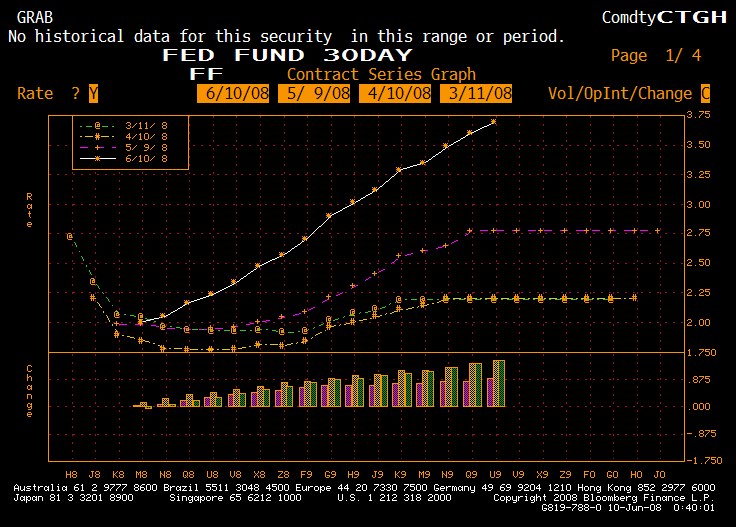
One of the reasons for this is that the Fed has managed to calm the short term lending markets. They have also managed to defuse a possible crisis among derivative books by bailing out Bear Stearns with the aid of JP Morgan. Also, GDP growth hasn’t gone negative yet, at least the way the Government calculates it. As a result, Ben Bernanke feels that the risk of a substantial downturn has receded, and so, the next focus of the FOMC will be inflation.
Now, I don’t think the answer for the Fed is that simple. That said, there are many that would welcome a tighter FOMC policy.
- China is importing our lax monetary policy, and they are unsuccessfully trying to fight the implications of the policy, because they won’t raise their exchange rate. They will have to eventually, perhaps after the Olympics, but a tighter US monetary policy relieves some of their stress.
- Europe would welcome a tighter US monetary policy, because it would relieve pressure on the rising Euro. As it is, the ECB with its single mandate is moving to fight inflation. Even the Bank of England is not loosening aggressively, and their housing problems may be proportionately greater than those in the US.
- The Gulf States would like a stronger US Dollar to help arrest the inflation that they are importing.
- Savers in the US might like higher rates.
But the trouble is that there are still weak spots that might cause the Fed, which has a dual/triple mandate to not tighten monetary policy. (Dual — inflation and unemployment. Triple — financial system solvency, inflation and unemployment.)
- The Fed is not out of the woods yet on real estate related credit. I commented many times at RealMoney that Home Equity Lending would be a big problem, back in 2006. I also warned on option ARMs. Well, both are looming problems now.
- This will lead to problems in the regional banks. Many of them are exposed.
- I still expect residential real estate prices to fall further.
- The correction in commercial real estate prices has only begun.
- Also, investment banks are still delevering and taking writeoffs. Lehman is the most recent poster child there, but other investment banks could still be affected.
- Beyond that, we have defaults rising in speculative grade credit, which will do damage directly, and through the CDOs that they are in.
- Places like the Philippines may be canaries in the coal mine — they may be experiencing outflows of hot money at present.
I think the Fed has less freedom to act than is commonly believed. As Yves Smith has commented at his blog, the Fed may have painted itself into a corner. I think the risks from inflation, unemployment, and financial system weakness are fairly well balanced. As it stands, the Fed has adopted the following policy:
- Don’t let the monetary base grow. Sterilize all new lending programs.
- Allow the banks freedom to expand their lendings; informally relax regulations for now.
- Bail out any significant systemic risks.
- Work out kinks in the short term lending markets through new programs.
The Fed may make some of those new programs permanent, but then they will need to find a new policy equilibrium involving greater tightness elsewhere in their policy tools. They will also need to decide what to do regarding investment bank leverage, both direct and synthetic. They will also have to figure out what comes first if there is a broader banking solvency crisis, and/or significant shrinkage of real GDP with a rise in unemployment.
It is my guess that Dr. Bernanke is talking a good game today, but that the Fed’s policies will be loose toward inflation, should systemic risk or unemployment prove to be more difficult problems than currently advertised today. They are not out of the woods yet.
David,
The Bank of Canada is getting in on the anti-inflation act too. They left rates alone today, when the market had expected either a 25 or 50 bps cut. 2-year bonds in Canada are getting killed today.
Steve
DM – “It is my guess that Dr. Bernanke is talking a good game today…”
The fed’s current policy appears to be exactly that. Having gone about as far as they dare with actions, they’re going to work on communications as a means to control expectations and the actions which flow from expectations.
In particular, they need to keep inflation expectations “anchored” in the face of common experience to the contrary, and prevent the moral hazard arising from their past actions from engendering a new era of systemically risky behavior in the financial system.