
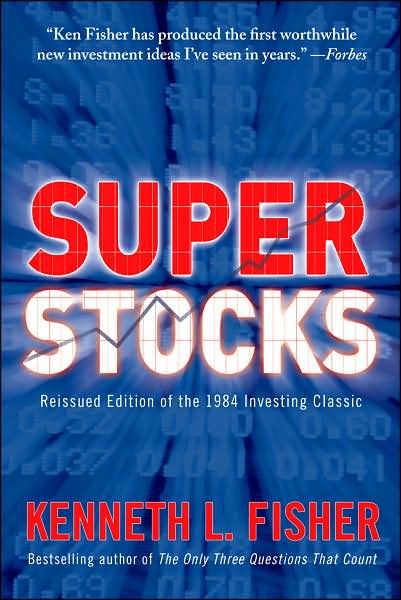
 When I review books, I don’t just review new books.? I try to share with my readers the books that have helped me become a better thinker on investments.? Fortunately, in this case, the 1984 book Super Stocks was reprinted in 2007.? Perhaps that validates my opinion that this is a valuable book.
Ken Fisher focuses on the concept of Price to Sales [P/S] ratios as a means of analyzing cheapness in companies.? Cheapness, yes, but predicated on the concept that a new product, process improvements, or better management will make more profits from the sales, or improve sales volumes and perhaps profit margins.
Though the examples are from the early 80s, the writing is clear enough that one can get the idea of how it might apply today.? You would get the same feeling from Ben Graham’s classic The Intelligent Investor, where the examples were from the 50s and 60s, but the truths are timeless.
Why choose this book to review now?? Profit margins are artificially high, and will come down somewhat from here, even if they remain above average.? How can we find cheap stocks when profit margins are so high?? Use P/S, or Price-to-Book [P/B].
My own investing looks at a wide number of valuation figures, but across an economic cycle, I give more or less weight to each variable.? When things are bad, I give more weight to P/S and P/B.? During the recovery, I emphasize P/E on a forward basis.? When the bull market is in full swing, I let industry selection dominate, which gives me more market sensitivity. As another example, I play up EV/EBITDA when buyouts are becoming common, and drop it as a criterion when buyouts are not being funded.
So, unlike Peter Lynch, paying attention to the macroeconomic environment can positively affect your performance, if you do it intelligently.
Super Stocks is very consistent with my eight rules, particularly the rules:
- Stick with higher quality companies for a given industry.
- Purchase companies appropriately sized to serve their market niches.
- Analyze the use of cash flow by management, to avoid companies that invest or buy back their stock when it dilutes value, and purchase those that enhance value through intelligent buybacks and investment.
Fisher spends a decent amount of time on balance sheets, market share, competitive advantage, and use of cash flow for future investment.? Though I don’t endorse everything in the book, like his price-to-research ratios, there are a lot of good concepts for the average investor to consider, and benefit from.
Full Disclosure: If you enter Amazon through any of the links on my site (mainly on the leftbar) and buy anything, I get a small commission.? This is my version of the tip jar, and it doesn’t increase your costs at all.