It was only two months ago when I wrote my surprisingly well-received post, Ten Notes on Crude Oil: The Fixation. It was surprising to me because I’m not an expert on energy issues. I’m just a good generalist portfolio manager who knows a little about a lot. So, I have to be careful what I say, and candidly say that I’m not sure, when that’s the case.
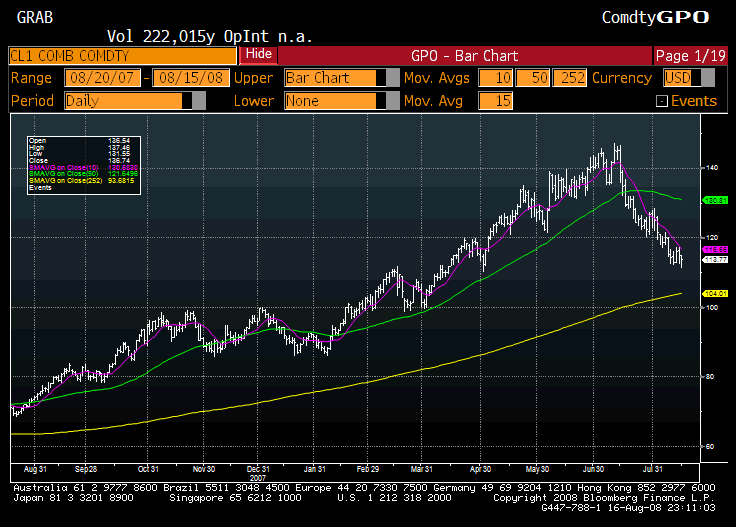
Here’s a graph of the price of crude over the last year.? Over the last two months, it was up fast in month one, and down faster in month two.? What a ride!
As prices rose in late June, President Bush called for lifting the restrictions on offshore drilling in the US.? If opening up ANWR was tough, this would be tougher, as there is a visceral feeling against drilling in states with significant coastal populations, even if the rigs can’t be seen from shore.
Another hurdle would be the lack of equipment capable of doing the drilling in the short run.? Think of all the industries with relatively tight capacity constraints that would be stimulated if the ban were lifted.? Drill-ships and rigs, specialty steel, coal, industrial gases… and more.? It would be quite a project.
As crude oil rose over $130/barrel, the exchanges moved to put limits on oil contracts.? Two weeks before the peak, credit conditions were leading shorts to cover positions.? Refiners began to let their crude inventories fall because it was getting more expensive to finance them.? So, as the market approached the price peak, there were a wide number of financing issues pushing the market around.
One week after the price peak, the demise of SemGroup made the headlines.? They were reportedly short the crude oil market, and were forced buyers covering near the peak.? Capitalistic markets are unstable, and that is mostly good thing, because it motivates market players to respond to the need.? At any significant peak/valley, some player that was taking significant chances gets uncovered as a fool who took big risks without a sound capital base, exacerbating the peak, and, the decline, though the fool doesn’t get to benefit.
As the price peak passed, this article posited why we would see oil down below $100.? The summary answer is demand destruction and supply encouragement.? High prices are the solution — users don’t buy as much, and suppliers see reason to produce more.? As for demand destruction, it is well underway in the US, but in places where prices are subsidized, or are artificially high due to taxes, the process is slower.
Every market has momentum players.? Momentum is a really simple strategy; do what the majority are doing.? That exacerbates the swings in the market, but given the needs of hedgers, whether they are producers or users, momentum tends to occur anyway for reasons of fear.
No surprise that high oil prices lead to conservation efforts on the part of corporations, as well as individuals.? High prices solve themselves.
One month after the recent peak, journalists point out the recent price peak.? Hindsight is 20/20, gentlemen.? I understand the need to explain what is going on, but I have more respect for those that take a position before the reversal, when it is painful to do so.
Crude oil is inelastically supplied and demanded, so it it should be no surprise that the price is volatile.? Small changes in expectations can produce big results, as is posited in this article on queueing theory.
I am not a peak oil “true believer.”? I believe that it is more likely than not.? As a result, I offer some time to the other side, because we can learn from them.? How much of the recent price spike is supply and demand, and how much? is speculation?? Hard to disaggregate, because speculation is normal to capitalistic markets.
Buffett: my guess is that he is accumulating a large stake in ConocoPhilips.? I could be wrong here; badly wrong, as he could be selling off.? But COP is cheap, has a large refining capacity, as well as significant E&P efforts around the globe.
Finally, a book review.? I was going to do reviews of two books on opposite sides of the peak oil question, but the book on the negative side was never sent to me.? 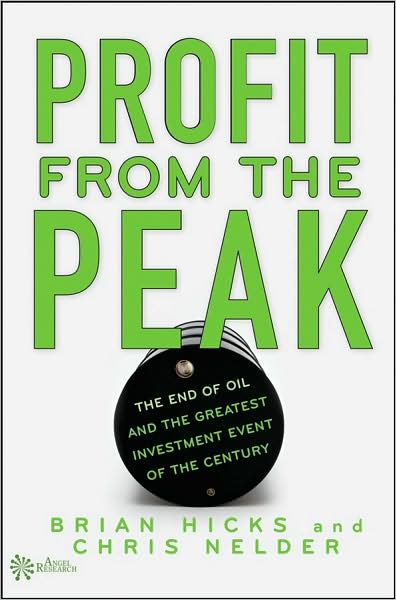
As for the pro-peak oil book, Profit from the Peak: The End of Oil and the Greatest Investment Event of the Century, my disappointment was that it was not written by an expert in the industry.? He posits that not only are we at peak oil, but we are at peak energy.? We are at or close to the peak in many forms of energy: coal, uranium, natural gas, etc.
This is a bold claim, an one that I think will be partially falsified, as men make efforts to expand energy with the incentives that come from high energy prices.
Full disclosure: long COP, also anyone entering Amazon.com through a link on my site, and buying anything, ends up giving me a commission.? No increase of cost to you.? It is my version of the tip jar.
Crude Oil = over valued commodities
2 more month, 90 USD per barrel.
David, you write that “Momentum is a really simple strategy; do what the majority are doing.” I would take issue with this statement. As most studies of the “disposition effect” show, the majority of investors sell their winners and hold onto or buy more of their losers, and by a margin of roughly 1.8:1. So isn’t momentum investing really providing liquidity to the market by doing the opposite of what most investors do?
Cheers.
James
High prices do encourage more oil exploration and more efficient use of oil, but there are lag times of several years on both counts. It can take 5-10 years to produce oil from a new discovery, and it can take years for most drivers to switch to more fuel efficient vehicles, as the switching costs are often higher than the savings in fuel. For those reasons, I’m confident that the secular bull market in oil will continue for another five years, despite the current cyclical correction. This isn’t the first cyclical correction in oil prices since the current bull market began, and it probably won’t be the last.
Oil prices will soon skyrocket.
According to energy investment banker Matthew Simmons and most independent analysts, global oil production is now declining, from 74 million barrels per day to 60 million barrels per day by 2015. During the same time demand will increase 14%.
This is equivalent to a 33% drop in 7 years. No one can reverse this trend, nor can we conserve our way out of this catastrophe. Because the demand for oil is so high, it will always be higher than production; thus the depletion rate will continue until all recoverable oil is extracted.
Alternatives will not even begin to fill the gap. And most alternatives yield electric power, but we need liquid fuels for tractors/combines, 18 wheel trucks, trains, ships, and mining equipment.
We are facing the collapse of the highways that depend on diesel trucks for maintenance of bridges, cleaning culverts to avoid road washouts, snow plowing, roadbed and surface repair. When the highways fail, so will the power grid, as highways carry the parts, transformers, steel for pylons, and high tension cables, all from far away. With the highways out, there will be no food coming in from “outside,” and without the power grid virtually nothing works, including home heating, pumping of gasoline and diesel, airports, communications, and automated systems.
This is documented in a free 48 page report that can be downloaded, website posted, distributed, and emailed: http://www.peakoilassociates.com/POAnalysis.html
I used to live in NH-USA, but moved to a sustainable place. Anyone interested in relocating to a nice, pretty, sustainable area with a good climate and good soil? Email: clifford dot wirth at yahoo dot com or give me a phone call which operates here as my old USA-NH number 603-668-4207.
Clifford, you get one promotional post. Next promotional post is spam. After that, buy an ad for my blog at http://blogads.com. Surprisingly cheap, and in a prominent place on my blog, not buried in the comments.