Here’s my updated graph of the composition of the Fed’s balance sheet, with modifications as suggested by some of my readers:
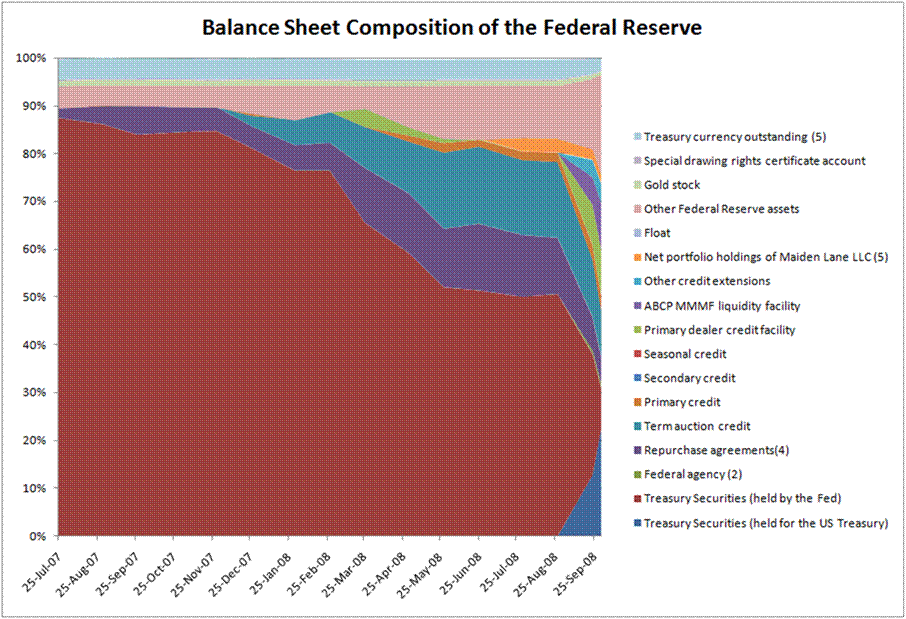
As you can see, the percentage of the Fed’s balance sheet containing Treasuries, whether held for itself, or together with the government is declining.? Let’s look at it another way that contains some editorializing by me:
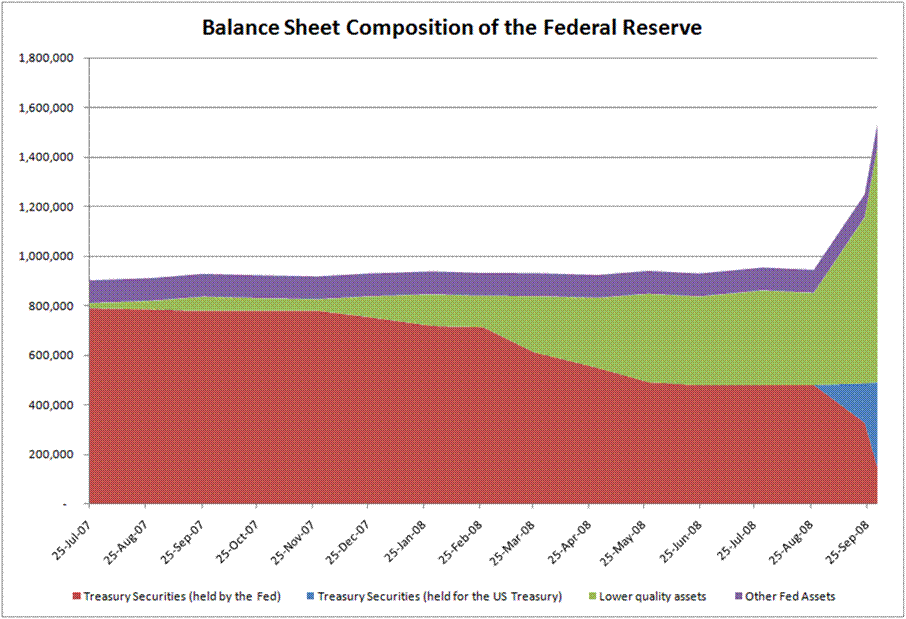
By lower quality assets, I simply mean assets less creditworthy than the US Government or its agencies.? That’s an estimate on my part.? Why does balance sheet quality at the Fed matter?? If the Fed wants to extend credit, it can more easily do so by having higher quality assets, like Treasuries.? Now, the Fed can lose money, and it means that seniorage profits that go to the US Treasury get reduced, or go negative, which implies increased borrowing or taxation.

I can’t remember which Greek philosopher said something like, “Democracy is doomed when people learn that they can vote to get money for themselves from the public treasury.”? I know Tyler and de Tocqueville said something like that as well.? At a time like this there are a lot of demands on the public treasury, and they are growing:
There is a trouble here.? In the absence of a functioning market, how can the bureaucrats at the Fed figure out the right prices/yields to charge?? This is the same problem as valuing level 3 assets, but without a profit motive to aid in focusing the efforts of the businessman.
Now, the little graph above (from The Economist) describes the real cause of the problems.? As in the Great Depression, there was too much debt financing of assets.? The debt was more liquid than the assets, as well.? Borrow short, lend long.? Oh, and remember, the graph above does not contain the hidden debts of the Federal Government (Medicare, Social Security, and old unfunded DB plans), the states (low funded DB plans and unfunded retiree medical plans), and corporations (poorly funded DB plans).? Nor does it take account of the synthetic leverage from derivatives.
What we are seeing at present is not a reduction of the debt structure of the economy, but a shift from public to private hands.? That can lead to four results, when the debt of the US Treasury is so large that it cannot be serviced:
- Inflation when the Fed monetizes the debt,
- Depression from vastly increased taxes,
- Debt repudiation (whether internal, external, or both), or
- Japan-style malaise for a long time.
Japan-style malaise is sounding pretty good. ;)? No growth for several decades while the government debt bloats, and financial balance sheets slowly normalize.? Trouble is, we don’t internally fund our debts.? At some point, our creditors will tire of throwing good money after bad, and then the next cycle can begin in earnest, when the neomercantilistic nations give up, and accept that their investments in the US are worth a lot less than they had thought, and allow their currencies to come to a fairer level against the US dollar.
Financial intermediation has limits.? Financial and economic systems function better at lower levels of leverage if you want it to be sustainable.? Granted, you can have big boom phases if you pile on the leverage, but they will be followed by big bust phases, where the deleveraging is painful.
All of the government’s/Fed’s choices are bad here.? Dr. Bernanke is on a hopeless task, and his theories, borne out his academic studies of the Great Depression, means that we will get a new sort of Great Depression.? There is no easy solution; it is merely a situation where we choose which poison we want to take while the deleveraging goes on.? My guess is that we see some combination of malaise plus inflation.
As Martina McBride said in her song “Love’s the Only House,” “Yeah, the pain’s gotta go someplace.”? The pain is going somewhere; our policymakers are merely determining where.
PS — I am by nature a moderate optimist.? I invest in equities, and many of my sub-theories of the world, i.e., how well will the life insurance business fare, and how well will global demand fare versus that of the US, are being tested now, and I am finding myself the loser on both counts.? Yeah, the pain’s gotta go someplace
Dude, did you steal this or did this other guy steal from YOU?
http://seekingalpha.com/article/99090-the-beginning-of-the-endgame-for-monetary-policy-redux?source=headline1
I think it was a simple attribution mistake at Seeking Alpha. Thanks for letting me know. I have sent them a polite note; they are my friends all.