The Federal Open Market Committee decided today to lower its establish a target range for the federal funds rate 50 basis pointsof 0 to 1/4 percent.
The pace of economic activity appears to have slowed markedly, owing importantly to a decline in consumer expenditures. Business equipment spending and industrial production have weakened in recent months, and slowing economic activity in many foreign economies is damping the prospects for U.S. exports. Moreover, the intensification of financial market turmoil is likely to exert additional restraint on spending, partly by further reducing the ability of households and businesses to obtain credit.
Since the Committee’s last meeting, labor market conditions have deteriorated, and the available data indicate that consumer spending, business investment, and industrial production have declined.? Financial markets remain quite strained and credit conditions tight.? Overall, the outlook for economic activity has weakened further.
Meanwhile, inflationary pressures have diminished appreciably. In light of the declines in the prices of energy and other commodities and the weaker prospects for economic activity, the Committee expects inflation to moderate further in coming quarters to levels consistent with price stability.
Recent policy actions, including today?s rate reduction, coordinated interest rate cuts by central banks, extraordinary liquidity measures, and official steps to strengthen financial systems, should help over time to improve credit conditions and promote a return to moderate economic growth. Nevertheless, downside risks to growth remain. The Committee Federal Reserve will monitor economic and financial developments carefully and will act as needed to promoteemploy all available tools to promote the resumption of sustainable economic growth and to preserve price stability. In particular, the Committee anticipates that weak economic conditions are likely to warrant exceptionally low levels of the federal funds rate for some time.
The focus of the Committee’s policy going forward will be to support the functioning of financial markets and stimulate the economy through open market operations and other measures that sustain the size of the Federal Reserve’s balance sheet at a high level.? As previously announced, over the next few quarters the Federal Reserve will purchase large quantities of agency debt and mortgage-backed securities to provide support to the mortgage and housing markets, and it stands ready to expand its purchases of agency debt and mortgage-backed securities as conditions warrant.? The Committee is also evaluating the potential benefits of purchasing longer-term Treasury securities.? Early next year, the Federal Reserve will also implement the Term Asset-Backed Securities Loan Facility to facilitate the extension of credit to households and small businesses. ?The Federal Reserve will continue to consider ways of using its balance sheet to further support credit markets and economic activity.
Voting for the FOMC monetary policy action were: Ben S. Bernanke, Chairman; Timothy F. Geithner, Vice ChairmanChristine M. Cumming; Elizabeth A. Duke; Richard W. Fisher; Donald L. Kohn; Randall S. Kroszner; Sandra Pianalto; Charles I. Plosser; Gary H. Stern; and Kevin M. Warsh.
In a related action, the Board of Governors unanimously approved a 5075-basis-point decrease in the discount rate to 1-1/4/2 percent. In taking this action, the Board approved the requests submitted by the Boards of Directors of the Federal Reserve Banks of Boston, New York, Cleveland, Richmond, Atlanta, Minneapolis, and San Francisco. The Board also established interest rates on required and excess reserve balances of 1/4?percent.
The Upshot
We’re done with Fed Funds in entire.
On to quantitative easing.? (Japan had the advantage of running a current account surplus… how will it work for us with a deficit?)
The princely rate of 1/4% gets paid on all reserve balances at the Fed, both required and excess.
The Fed is looking at deflation, not price stability.
The Fed will possibly invest more into long Treasuries, with uncertain prospects.
The Fed will continue to make it up as it goes, and keep expanding its balance sheet, adding liquidity where it wills, and replace functions of the private lending markets in the name of fixing the lending markets.
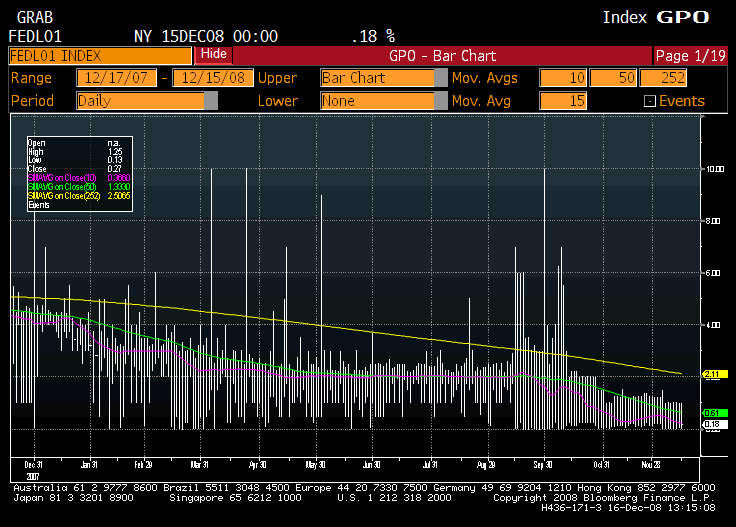
Time again for another underwhelming FOMC meeting.? As I said before the last FOMC meeting, in The Fed Funds Target Rate is an Exercise in Futility, we are so close to the zero bound that further easing will do little.? Here’s a graph of effective Fed funds:
That is not to say that the Fed is out of options, but the FOMC and what it has to say, matters less and less.? The various lending programs of the Fed are where the action is, where they monopolize liquidity for the markets they deem worthy of service, while starving everything else of liquidity.
As others have commented, and I can’t remember where, the low Fed funds rate reduces the powers of the regional Federal Reserve banks, and raises the power of the NY Fed and the Board of Governors, because the regional Federal Reserve banks don’t have much play in the new lending programs.
The low fed funds rate affects high credit quality money market funds, many of which will close to new investments (and/or reduce fees).? Otherwise, the low rates may cause them to “break the buck.”? As it is, rates will be near the zero bound for a long-ish time, unless we get a spate of inflation due to dollar depreciation.
I’ll be back with a redacted version of the FOMC Statement after it is issued.
When I think about the present market difficulties, I think about both the situation as a whole, and the personalities involved.? We might look at Bernie Madoff as a poster child for the current distress, but back during the Great Depression. we might have considered Richard Whitney.
Though the conditions are different, when conditions move from boom to bust, cheaters get revealed — those who were relying on good times in order to make good on promises gone wrong.? Both Madoff and Whitney had sterling reputations as well, and they both played a significant role in the trading of the market.
Perhaps big frauds require seemingly upright men who command trust from their peers.? Practices that can be gooten away with during a bull phase of the market will fall flat during the bear phase.
Aside from the Whitney story, Once in Golconda tells the story of boom and bust for the financial economy as a whole.? Taking chances ramped up, supported by a too-easy monetary policy.? After the peak, opportunities were few, and few had the spare capital to invest in ventures that were seemingly rich, as measured against boom conditions.? Such is the nature of scarce liquidity after a boom.
This is a fun book.? You can see the gathering storm as liquidity grows, and markets boom.? You can see the increasing furor nearing the peak.? At the peak, you can’t hear much.? During the fall you can hear investors go through the five stages of grieving as they watch their investments die.
This is a good book, well-written, and appropriate for our era.? I recommend it.
PS ? Remember, I don?t have a tip jar, but I do do book reviews.? If you enter Amazon through a link on my site and buy things from them, I get a small commission, and you don?t pay anything extra.? Such a deal if you wanted to get it anyway?
One of the great conceits in investments is trying to earn above average returns with low variability of returns.? Yet, when you consider the Madoff scandal, it is what can attract a lot of money from credulous investors.
One of the glories of a capitalistic economy is that markets are unstable, they adjust to point out what is no longer needed.? Often the adustments occur violently, because businessmen/consumers chase trends, which can lead to bubbles and bubblettes, until the cash flows of the assets cannot bear the interest flows on the debts that have been created to buy the assets.? Attempts to tame this, such as Alan Greenspan’s aggressive provisions of liquidity just build up more debt for an economywide bubble, followed by a depression.? We got the Great Moderation because of trust in the Greenspan Put.? The Fed would only take away the punchbowl for modest amounts of time, so speculation on debt instruments, real estate, financial institutions, etc., could go on to a much greater degree.? Boom phases would be long; bust phases short and low-impact.
There have been problems with lax regulation of bank underwriting, and investment bank leverage, but the key flaw was mismanagement of the money/credit supply.? Had the Fed held credit tighter during the ’90s and 2000s, we would not be here now.? The Fed could have kept the fed funds rate high, rewarding savings, perhaps leading to a lower cuurent account deficit as well.? Debt growth would have slowed, and securitization, which hates having an inverted or flat yield curve, would have slowed as well.? GDP growth would have been slower, but we would not be facing the crisis we have now.
Or consider housing, and how it became overbuilt because of lax loan underwriting, accommodative monetary policy, and a follow-the-leader mania.? Here’s an old CC post from the era:
1) For those with stable businesses that throw off a lot of earnings and cash flow, and want to dodge the tax man, here’s a possible way to do it, courtesy of the Wall Street Journal: start a defined benefit plan. Disadvantages: complex, relatively illiquid and expensive. Advantages: you can sock away a lot, and defer taxes until you begin taking your benefit, possibly (maybe likely) at lower tax rates.
(This message brought to you courtesy of one actuary who won’t benefit from the message itself… but hey, it helps the profession.)
2) Sea changes in the markets rarely take place in a single day or week. Tops, and changes in leadership tend to take place over months, and feel uncertain. Though Jim is pretty certain that it is time to shift out of energy, I am willing to hang on, and get my opportunities to average down if they come at all. My rebalance points are roughly 20% below current prices anyway, so I’d need a real pullback in order to add.
Though there may be temporary inventory gluts, the basic supply/demand story hasn’t changed, and energy stocks still discount oil prices in the 40s, not the 60s.
3) Contrary to what Jim Cramer wrote in his housing piece today, you can lose it all in housing. Granted, it would be unusual to see homeowners in multiple areas in the country lose their shirts all at the same time; that hasn’t happened since the Great Depression, and we all know that the Great Depression can’t recur, right?
Thing is, local hot real estate markets often revert; if the reversion is bad enough, it leads to foreclosures. Think of Houston in the mid-80s, and Southern California in the early 90s. For that matter, think of CBD real estate in the early 90s… not only did that threaten real estate owners, it did in a number of formerly venerable banks and insurance companies.
Real estate is not a one way street, any more than stocks are. We have never financed as much real estate with as little equity as today before. We have not used financing instruments that are as back-end loaded before. Finally, this speculation is being done on a basis where renting is far cheaper than owning, leaving little support for property prices if the incomes of leveraged homeowners can’t be maintained in a recession. (Oh, that’s right. No more recessions; the Fed has cured that.)
Look, I’m not pointing at any immediate demise of housing in the hot markets. I still think that any trouble is a 2006-7 issue. But this is not a stable situation; if you have a large mortgage relative to your income, make sure your employment situation is really stable. If you can make the payment, prices on the secondary market don’t matter. If you can’t… those prices matter a lot.
One more note: an average investor can sell all of his stocks in the next 20 minutes, with little effect on the market. This is true even in a bad market. In a bad real estate market, you can’t sell; buyers are gunshy — it is akin to what I went through as a corporate bond manager in 2002. There are months where there is no liquidity for some bonds at any reasonable price. So it is for houses in some neighborhoods when half a dozen “for sale” signs go up. No one can sell except at fire sale prices.
None
Well, that’s the macroeconomic problem with stability.? When it gets relied on, after a self-reinforcing boom, it goes away.? Trust in stability is dangerous in other contexts, though.? From another CC post:
Oil and Economic Strength (and a Rant on the Sharpe Ratio)
8/31/2005 3:13 PM EDT
I haven’t really talked about the issue of whether high oil prices portend economic strength or weakness for a good reason. No one knows. There are too many moving parts, and separating out the different effects is impossible; opinions here come down to more of one’s personality (optimist/pessimist) or investment positions (stocks/bonds/energy).
Even if someone did tests using Granger-causality, I’d still be suspicious of the result, whichever way it would point, because of the high probability of finding spurious correlations.
And, speaking of spurious correlations, since Charles Norton brought up the Sharpe ratio, I may as well say that it is a bankrupt concept as commonly used by investment consultants. First, variability is not risk. Losing money over your own personal time horizon is risk (which implies that risk varies for each investor). Second, there is not one type of risk, but many risks. Systematic risk may be measurable in hindsight, but never prospectively.
Third, any measure going off historical values is useless for forecasting purposes, because the values aren’t stable over time. When managers get measured in order for clients to make decisions, they are using the figures for forecasting purposes. It is no surprise that they don’t get good results from the exercise.
Why do figures like a Sharpe ratio gets used, then? Because consultants like simple answers that they can give to their clients, even if the answers yield no insight into the future. (It makes the math really simple, and allows a large number of strategies to be rapidly compared. It eliminates real work and thought.) Investment is a far more messy process than a few simple ratios can illustrate, and those that use these ratios get the results that they deserve.
Finally, an aside. Why am I so annoyed by this? Because of money lost by friends and clients who have been led along this path by investment consultants. There is a real cost to bad ideas.
Time Series Regression and Correlation (for wonks only)
7/12/2007 3:11 PM EDT
We’ve had a few discussions here recently involving correlation, so I thought I might post something on the topic. First, it is easy to abuse statistics of all sorts. Few on Wall Street really understand the limitations of the techniques; I have seen them abused many times, often to the tune of large losses.
When comparing multiple time series of any sort, the results can vary considerably if you run the calculation daily, weekly, monthly, quarterly, annually, etc. As you use fewer and fewer observations, the parameters calculated will change. The best estimate will be the one using all available observations, that is, assuming that the underlying processes that generated the time series will be the same in the future as in the past.
It gets worse when comparing the changes in time series. Here moving from daily to weekly to monthly (etc.) can make severe differences in the calculations, because two data series can be almost uncorrelated in the short-run, and very correlated in the long run. My “solution” is that you size your time interval to the time interval over which you make decisions. If daily, then daily, annually, then annually. Again, subject to the limitation that that the underlying processes that generated the changes in time series will be the same in the future as in the past.
But often, the results aren’t stable, because there is no real relationship between the time series being compared. High noise, low signal is a constant problem. Humility in financial statistics is required.
As an example, calculations of beta coefficients often vary significantly when the periodicity of the data changes. People think of beta as a constant, but I sure don’t.
For those who want more on this, there are my two articles, “Avoid the Dangers of Data-Mining,” Part 1 and Part 2.
Enough of this. Back to the roaring markets! Haven’t hit the trading collars yet!
Position: none, but intellectually short Modern Portfolio Theory [MPT]
My point is this: investors look for stable relationships that they can rely on.? Those relationships are precious few.? Sharpe ratios aren’t stable; correlation coefficients aren’t stable; return patterns aren’t stable.? They shouldn’t be stable.? They rely on a noisy economy? which is prone to booms and busts, and industries that are prone to booms and busts.? Seeking stable returns is a fool’s errand.? Warren Buffett has said something to the effect of, “I’d rather have a lumpy 15% return, than a smooth 12% return.”? Though we might mark down those percentages today, the idea is correct, so long as the investor’s time horizon is long enough to average out the lumpiness.
So, if we are going to be capitalists, let’s embrace the idea that conditions will be volatile, more volatile on a regular basis, but given the lower debt levels across the economy because of regular shakeouts, no depressions.? But this would imply:
Higher savings rates.
Greater scrutiny of balance sheets.
Aversion to debt, both personally, and in companies for investment.
Less overall financial complexity, and a smaller financial sector.
Lower P/Es at banks.
Even lower P/Es in non-regulated financials.? It’s a violent world.