
Aleph Blog

 Subscribe in a reader

Disclosure

This blog is produced by David Merkel CFA, a registered representative of Finacorp Securities as an outside business activity. As such, Finacorp Securities does not review or approve materials presented herein. By viewing or participating in discussion on this blog, you understand that the opinions expressed within do not reflect the opinions or recommendations of Finacorp Securities, but are the opinions of the author and individual participants. Neither the information nor any opinion expressed constitutes a solicitation for the purchase or sale of any security or other instrument. Before investing, consider your investment objectives, risks, charges and expenses. Any purchase or sale activity in any securities instrument should be based upon your own analysis and conclusions. Past performance is not indicative of future results. Finacorp Securities is a member FINRA and SIPC.

David Merkel

At my blog there are two main purposes: teaching investors about better investing through risk control, and tying all of the markets into a coherent whole.

Latest


Archives


Categories


  • Recent Comments:

    • Guillermo Roditi: OK, so am I the only one that thinks transaction taxes are ridiculous? It seems to me like they...
    • brad greenspan: very well put, david
    • najdorf: This is perhaps more of a comment on your #3, but large corporations imitate governments in this respect...
    • najdorf: Another (utterly non-mathematical) way to look at risk management is on a relative scale. We don’t...
    • Lurker: It’s good to get technical every once in a while. It lets some of these other commenters know who...
  • Recent Trackbacks:

  •  Subscribe in a reader

     Subscribe in a reader (comments)

    Subscribe to RSS Feed

    Enter your Email


    Preview | Powered by FeedBlitz

    Seeking Alpha Certified

    Featured blogger at Wealth Managers League

    Top markets blogs award

    The Aleph Blog

    Top markets blogs

    InstantBull.com: Bull, Boards & Blogs

    Blog Directory - Blogged

    IStockAnalyst

    http://www.wikio.com

    Search


    Advertising


    blog advertising is good for you

    Books I Have Reviewed

    Book Reviews

    Other Advertising

    Reverse Engineering the Rating Agencies

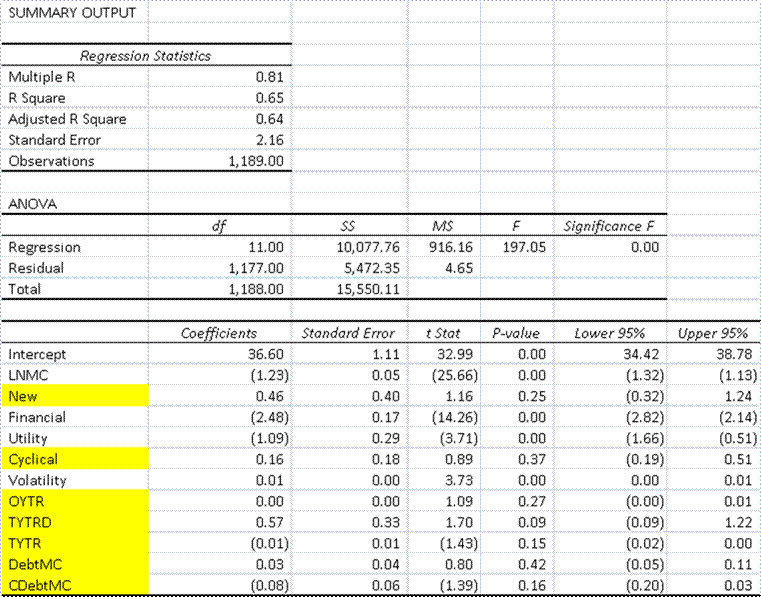
    I get odd quant projects.  Calculate the value of an odd CDO.  One of the subprojects involved in that required me to reverse engineer the senior unsecured corporate credit ratings of the rating agencies.  My parsimonious model explained roughly 2/3rds of the variation in ratings. What were my factors?

    • Market capitalization
    • Bond sector (Financial, Industrial, Utility, Cyclical)
    • Equity implied volatility
    • Past total returns, which were significant last year, and not this year.

    Note the absence of obvious fundamental factors.  I tried a bunch of factors, but none proved consistently significant.

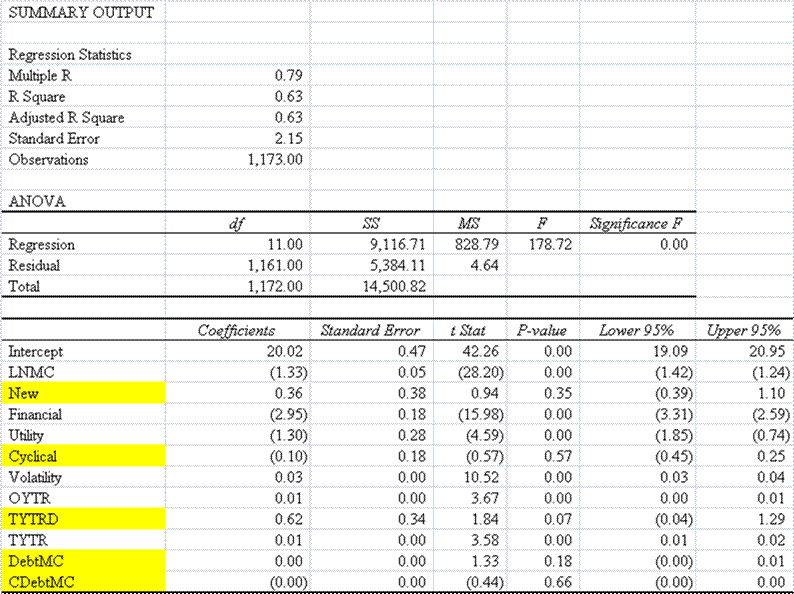
    My regression coefficients were very similar in 2007 and 2008.  I think the model is fairly stable.

    Given the fundamental models used by the rating agencies for their ratings, this may mean that the markets reflect the analyses of the rating agencies.

    For the average investor, this simply indicates that the values that the markets calculate in the short run are largely consistent with more complex fundamental models on average in this case.

    -=-=-=-=-=-=-==–=-=–==-=-

    For those that understand Regression, here is the output of the main model at the 2008 year end:
    And here is the same output of the main model at the 2007 year end:

    output of the main model at the 2008 year end:
    Here are the variable definitions:

    • LNMC — natural logarithm of the market capitalization
    • New — Less than one year old
    • Financial, Utility, Cyclical — If not a Industrial firm, which is the default, what is the difference in credit quality?
    • Volatility — 90-day implied volatility
    • OYTR — one-year total return
    • TYTR — three year total return
    • TYTRD — has the firm been around for three years?
    • DebtMC — Debt/Market Capitalization
    • CDebtMC — Change in Debt/Market Capitalization over the past two years

    The dependent variable grades from 1 for a AAA company to a 22 if it is in default.

    One Response to “ Reverse Engineering the Rating Agencies ”

    1. doug ransom Says:

      I interpret the R-squared to mean your model accounts for a little over 1/2 the variability in ratings.

    Leave a Reply