
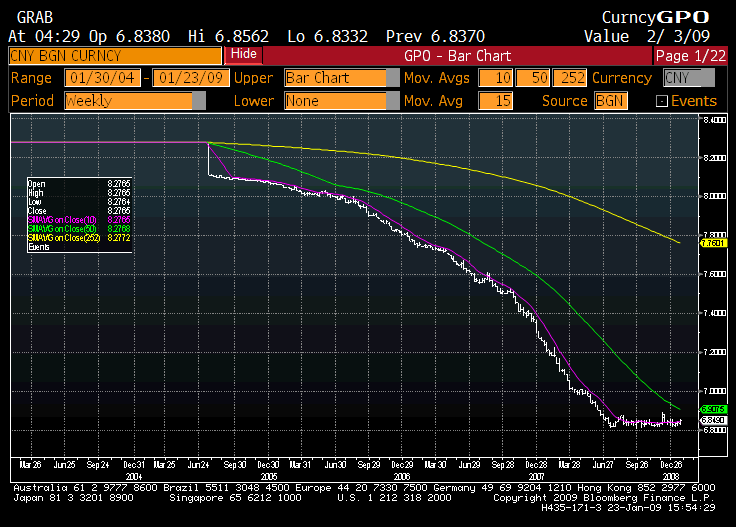
I’ve had an interest in the Yuan since the revaluation in 2005. To start this off, two RealMoney CC posts:
  |
|
David Merkel |
| Yuan Musings | ||
| 8/10/2005 10:46 AM EDT |
Today, the People’s Bank of China, in a speech given by central bank governor Zhou Xiaochuan, announced the currencies that are in the basket against which it sets the value of the yuan. They are the currencies from the following nations, excerpted from the speech:
China’s major trading partners are the United States, the Euro land, Japan, Korea, etc., and naturally, U.S. dollar, euro, Japanese yen and Korean won become major currencies of the basket. In addition, China also trades significantly with Singapore, U.K., Malaysia, Russia, Australia, Thailand, and Canada, currencies of these countries are also important in determining China’s RMB exchange rate.
Nice. But the weights and whether the weights are fixed were not given either. I’ve run a constrained regression model using data from the last 15 trading days (which only gives me 4+ degrees of freedom), constraining the lesser currencies to a 10% weight at most. What I end up with is that the U.S. dollar is in the high-80% range in terms of weight in the basket. If true, it means that the change in the yuan peg accomplished little, as I suggested at the time.
This is a very tentative conclusion, because I need more data. Two weeks from now, I will be able to shed more light on this.
As an aside, I have a model for the Singapore dollar, where the basket weights aren’t given, and it’s very predictable and normal-looking. They clearly have fixed weights. Within two months, I should be able to determine whether the same is true of the Chinese yuan.
None
|
|
David Merkel |
| China’s Rigged Currency | ||
| 9/30/2005 4:10 PM EDT |
Please pardon a brief Friday rant on China’s currency. I have a model that attempts to figure out the weights on their non-disclosed currency basket. Given the multicollinearity problems of my model, here is what I think I know:
This may explain the recent move by China to change the currency bands for all currencies except the US dollar. It was getting too hard to do a controlled appreciation of the yuan versus the dollar while staying within their currency bands for the other currencies; it’s impossible to have more than one set of cross rates globally.
My guess here is that China is trying to please Washington in a slow way, but retain the benefits (to the government, and those connected with it) of a managed currency. Investment implication: business as usual in China; neo-mercantilism continues for now.
Position: none
-=-=-=-=-=-=-=-=-=-=-
For those that missed my logic at the time of the devaluation, China kept its currency fixed to the US Dollar until mid-2005, then appreciated it in a dirty float until mid-2008.? Since then it has returned to a dirty fixed rate versus the US Dollar.? Note that the last regime shift fits with when things really began to turn down in the global economy.
Make no mistake, China’s currency has been managed since 2005.? Timothy Geithner was correct when he said in his written responses to the Senate:
President Obama – backed by the conclusions of a broad range of economists ? believes that China is manipulating its currency. President Obama has pledged as President to use aggressively all the diplomatic avenues open to him to seek change in China’s currency practices.
Now, it was a mistake and impolitic to say that.? Given all the money that China has loaned the US in US Dollars, you don’t want to let the sucker know how badly he has lost money bite the hand that feeds you.? We need to send economic policymakers to media school so that they can know how their statements affect markets and foreign relations.? Learning on the job wears on us all.
I don’t have a big point here, except to say:
- China’s currency policy changed in mid-2008.
- China never let its currency float, even against a basket.
- Timothy Geithner needs to consider his words more carefully.
- We need to consider what a pseudo-fixed exchange rate implies for economic matters.
Personally, I don’t think that China keeping its currency artificially cheap can work in the intermediate-term.? But the Chinese Government does not think in terms other than what benefits their long-term control over China.? Other things can and will be sacrificed.? But maintaining control over domestic affairs matters greatly to the Chinese Government, and all foreign affaqirs must bow to that.
The pseudo-fixed exchange rate will require increased purchases of US assets, relative to? an appreciating Yuan regime.? Perhaps we should be grateful for that.? If so, we haven’t seen any benefits, and neither hasw China.
I wish I could give a crunchier conclusion here, but I can’t.? In our deflationary world, the temptations toward protectionism, even through currency policy, are significant.? It is no surprise that we are seeing this change now.