
I read every email sent to me, and every comment? written at my blog.? But much as I would like to, I can’t answer them all.? One comment to my last piece on this topic questioned the validity of accrual entries in insurance accounting.? I would like to say that the standards for GAAP reserve accounting are pretty good.? They need some tweaks here and there, but they do the job fairly well.
One of the things you learn as a fundamental investor is that the quality of accounting derived from accrual entries is always lower than that for cash entries.? There is an implicit assumption behind every accrual entry that someone will make good in the future to pay cash, whether the amount is fixed or estimated.
Accruals vary in quality.? Accounts Receivable are more reliable than inventories.? Who knows what fixed assets, property, plant and equipment are worth?? Pension obligations are squishy, the assumptions can be manipulated within reason.? Deferred tax assets rely on the ability to earn more money, but most companies with the deferred tax assets have lost significant money in the past.? Will the company bounce back?
And there are intangibles.? Goodwill is only worth something if a company earns cash from operations in excess of net income over the long run.? Capitalized R&D, software costs, must produce cash flows that justify capitalizing the expenses, otherwise capitalizing is merely deferring losses.
So there are tests such as normalized operating accruals that for industrial companies and utilities can flag many companies that look cheap, but may not be, because too much of their income comes from accrual entries.
With financial companies, the problem is worse, because financial companies are a bag of accruals.? What are the loans worth?? What are those weird structured securities worth?? And with insurance it gets tougher.? What level of claims do you expect to pay out and when?? Will you recover the amounts that you invested in acquiring the policies that have been written?
Tough questions, but they are what accounting rules have been designed to try to answer.? Because there is complexity, unscrupulous management teams can take advantage of the flexibility.? That does not mean the rules are wrong, though.? No human system can be both consistent and comprehensive.? There are tradeoffs between modeling the details of a company’s financials accurately, and doing the accounting consistently across corporations.? To what degree do you make accounting “cookie cutter” versus tailored?? That is the tough question that vexes those that set the accounting standards.
I would add that insurance accrual quality is subject to three factors:
- Length of the accrual — longer is worse.
- Uncertainty of the contingency in question — uncertainty of amount and timing?
- Does the law of large numbers apply?? What is uncertain in specific, may be more predictable in aggregate.
I received another comment, and initially I said, “I can’t get that done.? Yes that would be good but….”? Here is the comment:
Doug Says:
It would be interesting to normalize the reserve charges two ways:
1) Adverse reserve development as a % of beginning reserves.
2) The ratio in #1 above compared with the industry.
While these reserve charges were bad, long-tailed P&C insurers were taking similar reserve charges ? even the more ?responsible? ones.
Look at the results of one of AIG?s smaller competitors ? W.R. Berkley. Similar business mix and a charismatic CEO to boot. Same string of reserve charges, but the CEO is still there, and investors got a nice 20% annual rate of return from 2000. The difference? AIG was trading at 4x book value in 1999, while Berkley was trading below book.
So I went and did it, choosing eleven peer companies that were large, having long tailed liabilities.? This was the peer group:
- ACE — ACE Limited
- BRK — Berkshire Hathaway
- CB — Chubb
- CINF — Cincinnati Financial
- CNA — CNA Financial
- MKL — Markel
- PRE — PartnerRe
- TRV — Travelers
- WRB — W. R. Berkley
- WTM — White Mountains Insurance
- XL — XL Capital Limited
I could have chosen more, but I thought these were representative of stockholder-owned insurers and reinsurers that write long-tailed P&C business.
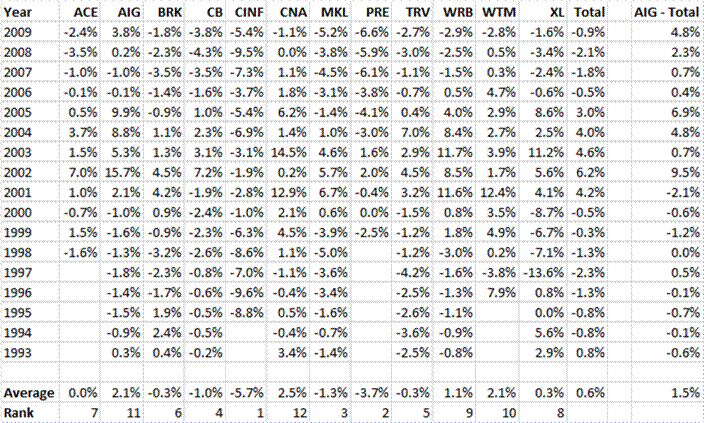
So what did I find?? I found that AIG was among the worst of major P&C insurance companies in terms of having to strengthen reserves from 1993 to the present.? AIG had to strengthen its reserves 2.1%/yr versus my peer group average of 0.6%/year.? CNA did worse, and White Mountains (a company that talks a lot about conservative accounting) was slightly behind.
Note that the four companies that did not stretch all the way back to 1993 in terms of reported numbers likely would have looked better, because they missed some favorable underwriting years.
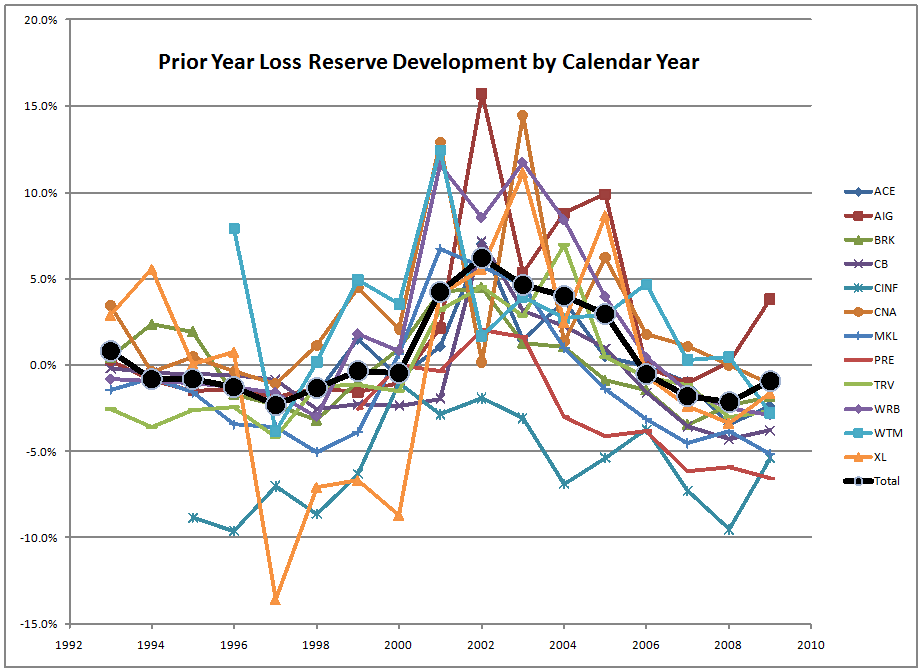
Here is the graph of the twelve companies, and the average:
And here is the graph of the companies that were not as good as the average:
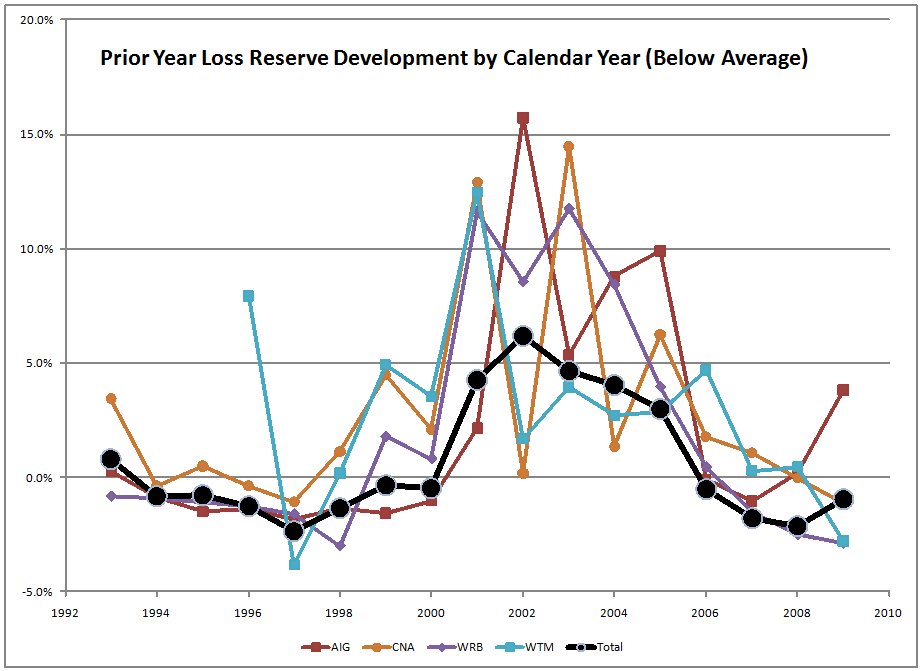
The clear conclusion is that AIG was among a group of P&C insurers that were less conservative in reserving than most of their large competitors. CNA and White Mountains were much smaller companies — AIG was dropping a boulder into the pond.
Among all the other difficulties that AIG had, from a yield-seeking derivatives subsidiary, to life and mortgage insurance subsidiaries in trouble, this was just another facet of a company that played it fast and loose.? They under-reserved their P&C divisions, and there can be no reasonable defense on that topic.
PS — I like investing in P&C insurers and reinsurers that regularly release reserves for the business of prior years.? Conservative companies have high earnings quality, and are reasonable investments, despite all of the uncertainty.
Full disclosure: long PRE, CB
What does the ‘AIG – Total’ column represent?
Also, is your total column a straight average or a weighted average? I think a weighted average would be biased in AIG’s favor, since its reserve base is so much larger than the other companies’.
AIG – Total is AIG minus the weighted average of the other companies in each year. AIG was roughly 1/4 to 1/3 of the total weight in the reserves for the period studied. The average is weighted, because I am trying to measure the industry as a whole.
But 2.1% doesn’t seem like a big deal to me. What it says is that on average the company needs 2.1% extra reserves each year to pay for prior year deterioration which in turn was 1.5 percentage points worse than the average for the industry. How is that so bad?
For a big insurer, even a 1%/year deterioration in reserve position is pretty bad. It means overstating earnings by ~10% each year.