

The Economic Geography of Publicly-Traded Companies in the United States by Sector (II)
No, I’m not doing a part 3 of the “Dave” series, though I am tempted after today’s events.? One of the widows in our church insisted that her son contact me about a business deal he was entering into.? God especially looks out for widows, so I give them extra time.? Turned out to be a Nigerian-style scam emanating out of Malaysia.? Yuck.? Beware the too-good-to-be-true.? 99% of the time it too good to be true.
-=-==–==-=-=–=-=-==-=–==–=-==-=-=–==-=–==-=-
I had some data questions about part 1.? My data came from Bloomberg, and I used their “State of Domicile” field, and their “Industry Sector” field.
After part 1 of this series, I felt I would take this the opposite way, and go sector by sector, showing which states had the most of a given sector.? Here we go:
Basic Materials
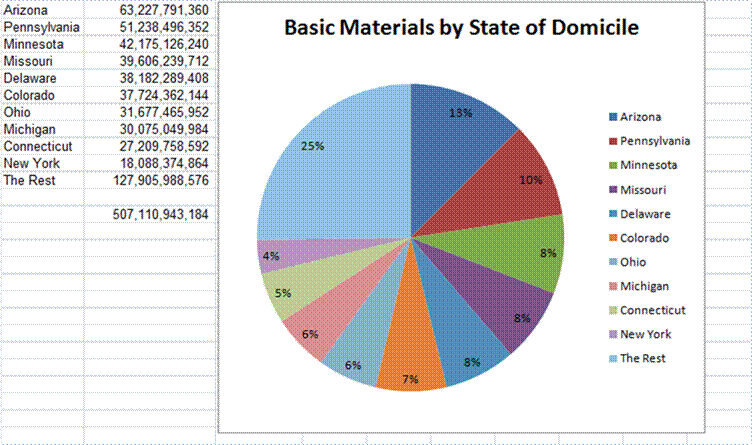
When I think of Basic Materials, I think of resource extraction: timber, mining, agriculture, non-energy stuff.? I don’t think about steel, industrial gases. or chemicals, but those are in there.? You could classify them as industrial, but they are building blocks for something else.
So, when I see Pennsylvania, it is mainly two industrial gas companies (APD, ARG) a coatings company (PPG), and a steel company (X).? Minnesota — Mosaic, and Ecolab (Chemicals). Missouri — Monsanto.? Delaware — I don’t have to look, it is DuPont.? Ohio — Cliffs Natural Resources (Iron Ore and Coal), Sherwin Williams (Paint), and Lubrizol (specialty chemicals).? Arizona (FCX, SCCO) and Colorado (NEM) I would expect — out west there is more resource extraction.
Communications
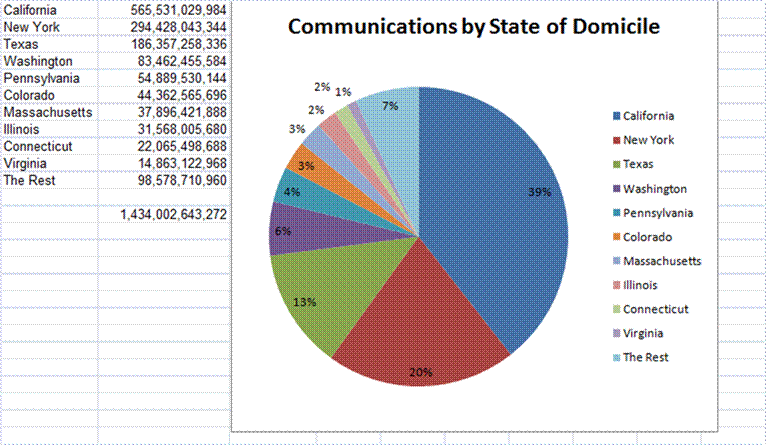
Communications is a much more concentrated industry, with companies mostly in the most populated states, California (GOOG, CSCO, DIS, QCOM), New York (VZ, NWSA, TWX, GLW), and Texas (T).? One could argue whether Cisco or Qualcomm should be techs, industrials, or communications.? Same for Google — Communications, Technology, where do advertisers go?? Google is an advertising company with a unique platform.
Consumer Cyclicals
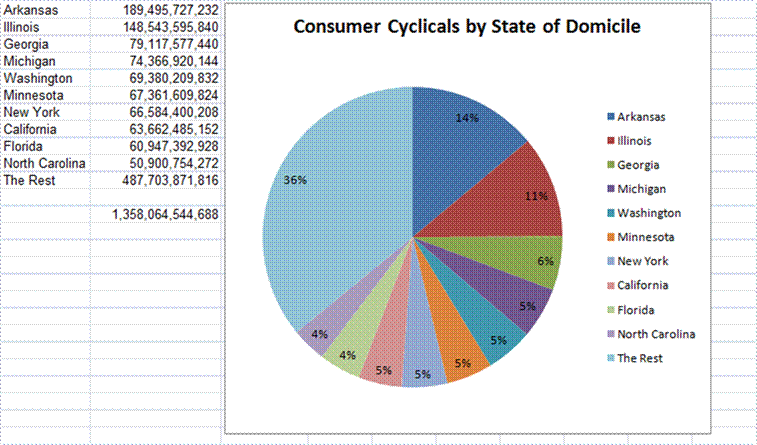
Think of retailers of goods that you don’t have to buy every month, and those that produce them.? This is a very spread-out sector geographically.? After the first two states, things are pretty even.? Arkansas has Wal-Mart.? Illinois has McDonalds and Walgreens.
Consumer Noncyclicals
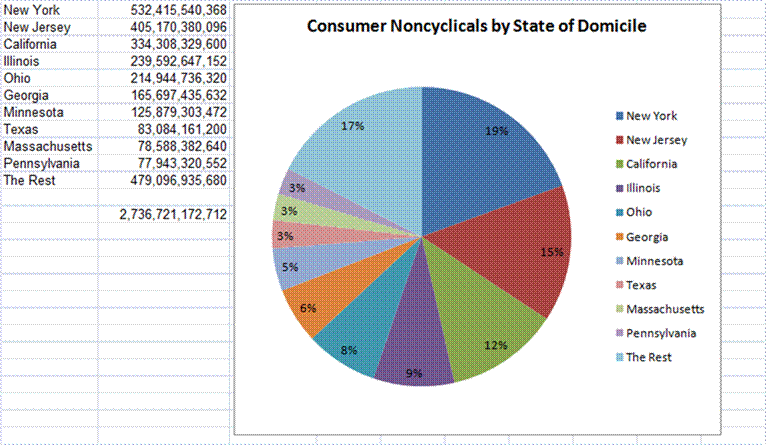
This sector is more concentrated than consumer cyclicals.? Here’s a breakdown for the biggest states:
- New York — Pfizer, Pepsico, and Philip Morris.
- New Jersey — Johnson & Johnson and Merck
- California — Visa and Amgen
- Illinois — Abbott Labs and Kraft Foods
- Ohio — Procter and Gamble
Now why Visa (and Mastercard) should be in this sector rather than Financials, I don’t know.? Same for drug companies, especially biotechs, why aren’t they thought of as technology companies?
When I look at the sorts of companies that are in each state for the consumer cyclicals and noncyclicals, there is little rhyme or reason to why they are where they are.? You could plunk them down anywhere there are sufficiently skilled populations, and the companies would probably work.? And, that said, almost every state has some of them.
Diversified
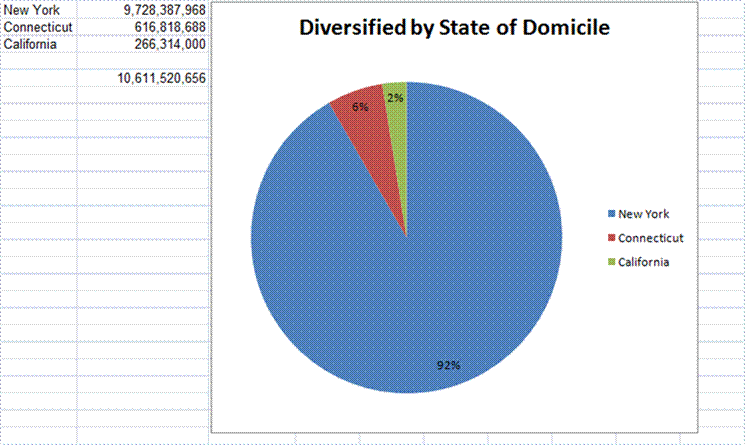
This classification should be eliminated.? There aren’t enough companies or market cap to justify it.? There are three largish New York companies: Leucadia, Icahn Enterprises, and Liberty Acquisition (a SPAC).? These are all financial buyers of assets, regardless of what sectors they buy in.? They are opportunistic, and should be classified as a type of financial company.? If Berkshire Hathaway is a financial company, and GE is an industrial, surely we can reclassify this small group of companies.
Energy
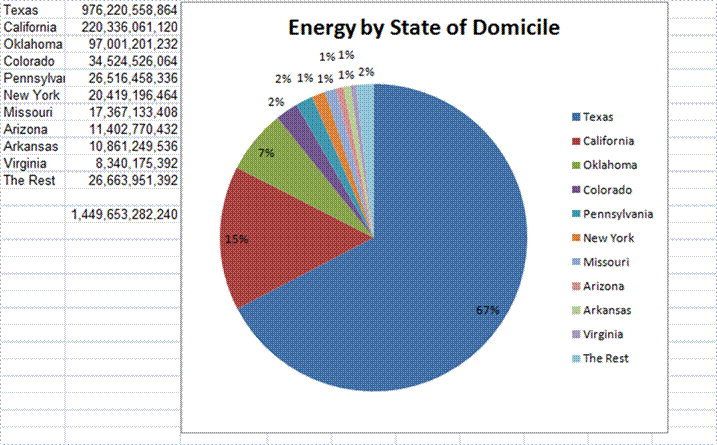
The most concentrated sector of all, and no surprise, given the development of the oil industry in Texas that Texas is huge and Oklahoma is large.? California is more of a surprise.? Everything else is dust on the scales.? Let’s see what the big three states have for big companies:
- Texas — Exxon Mobil, ConocoPhillips, Schlumberger
- California — Chevron, Occidental Petroleum
- Oklahoma –Devon Energy, Chesapeake Energy, and Williams Companies
Both Chevron and Occidental Petroleum began in California, with some significant early discoveries there before they prospected in other areas.? Oklahoma has natural gas-oriented companies.? Schlumberger is interesting because they were founded abroad, had a lot of operations in the US in the early days, then centralized their US operations in New York City in the 70s, before moving them to Houston in 2005.
Financials
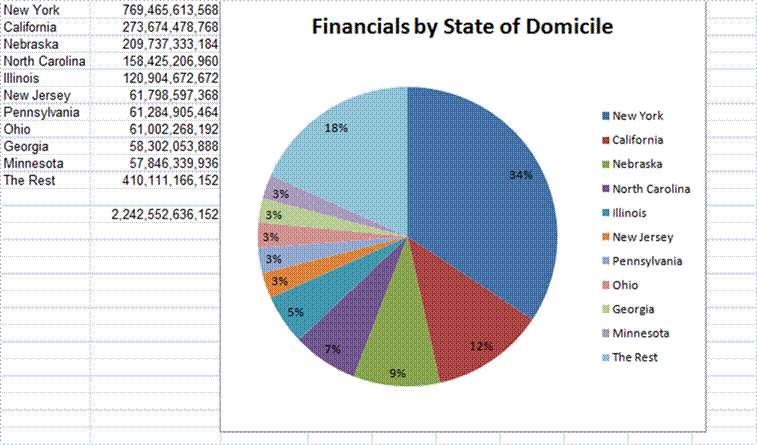
Financial companies could exist anywhere, but when the talent pool gets large, more companies locate where there are talented people.? In finance, that means New York.? Let’s go through the big companies for the top 5:
- New York — J.P. Morgan, Citigroup, Goldman Sachs (many companies — 110 in all)
- California — Wells Fargo (and 58 more that add up to a little more than Wells Fargo’s Market cap)
- Nebraska — Berkshire Hathaway (what, you were expecting First National of Nebraska?)
- North Carolina — Bank of America, BB&T
- Illinois — CME Group, Allstate, Equity Residential, Northern Trust, Aon (what a mix)
The banks dominate, but not the way they used to be, and New York is dominant, but not the way that it used to be.? Too many years of taking too much risk on too thin of a capital base caught up with them.? Now those that remain are the better capitalized companies with decent risk control, and those that got rescued by the government, leaving a legacy of moral hazard.
From some other research that I have done on my home state of Maryland, I can say that among small publicly traded companies, financials are everywhere — usually bitty banks or S&Ls.? This analysis cut of at $125 million of market cap, but there is a treasure trove of unknown financials that only DFA knows about.? (Okay, Hovde Capital, M3 Funds, and a few other specialists..)
Industrials
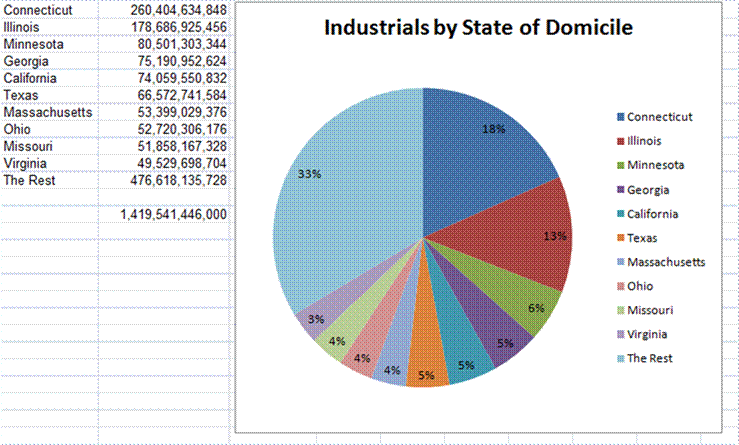
This is another very diversified sector, with only two states standing out: Connecticut (GE and United Technologies) and Illinois (Boeing, Caterpillar, Deere, and Illinois Tool Works).? Now, Boeing used to be headquartered in Washington State, but moved in 2001, to Illinois, who was the high bidder in tax incentives.? This reinforces to me the idea that most companies could have their headquarters almost anywhere there is a broad pool of talented people.? Probably not true for energy, technology, and biotech companies, but for others, quite possibly.
And, while not being as ubiquitous as financials, there are small industrial companies in out-of-the-way places scattered across the US.? Such was true with my Maryland research.
Technology
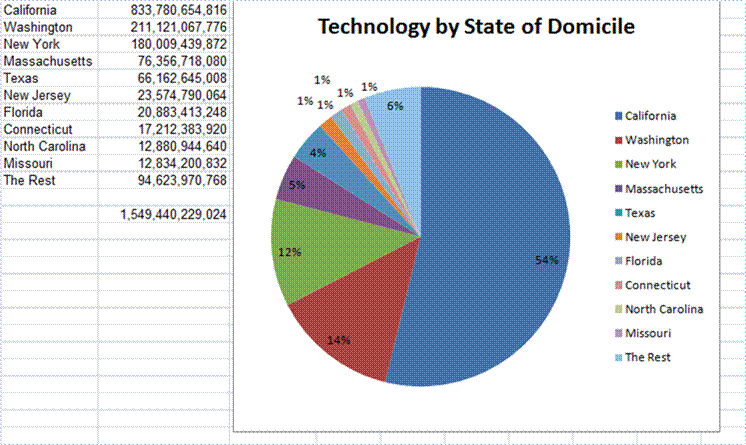
Information technology is dominated by California companies.? The big ones are Apple, Oracle, Intel, and Hewlett Packard.? There are 114 more with market caps over $125 million.? Washington State — Microsoft, nothing more.? New York — IBM, and little else.? California has a culture that tries new things, and developed a specialized culture for information technology, transcending the genius of just one bright firm.? Smaller companies needing talent in information technology flock there, because they can find it easily.
Utilities
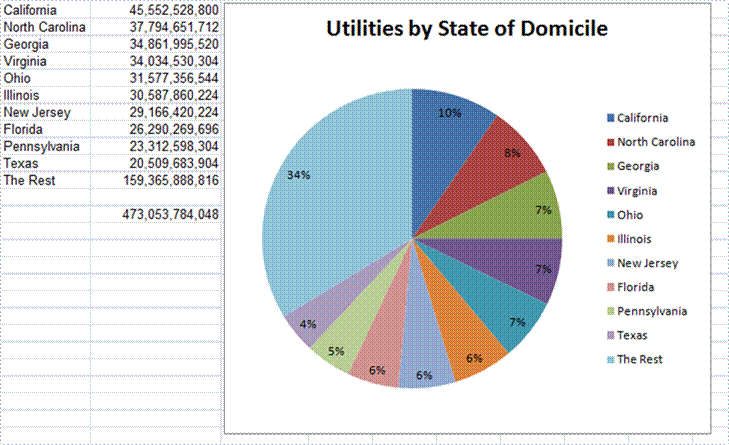
Finally, the most democratic sector.? Since utilities serve people, and it is only recently that they began merging across state lines, they are still scattered across the country, in almost every state, roughly proportional to the size of the state populations.? No one state stands out here, so I won’t list companies.
Summary
Most publicly-traded companies are located where they are because of the historical accident of where they started.? After that, proximity to specialized talent and resources drive location.? Beyond that, companies tend to clump disproportionately in larger states.
More to come in part 3, after a break.
Full disclosure: long ALL, PEP, ORCL, CVX and COP