
When I think about REITs, I think about their asset-liability structure.? With equity REITs, they own buildings where rents adjust annually, within limits.? They borrow using mortgages with 10-year terms.? Most of their bond offerings have ten year maturities.
But when articles cite the yields of Equity REITs (from NAREIT) they usually compare it to the 10-year Treasury to ascertain cheapness/dearness.? But is that the best measure?
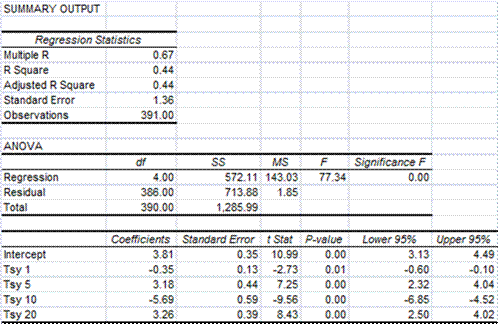 Possibly not.? In a multiple regression using 1, 5, 10 and 20-year Treasury yields, the coefficient for the 10-year yield is negative and significant.
Wait.? If you add up the coefficients for 5, 10, and 20 year yields, it is positive, where Equity REIT yields move 0.75% for every 1% move in the parallel move of 5, 10 and 20-year rates.
But what the configuration points out? is that when the curve is humped, where 10-year yields are high relative to 5 and 20-year yields, equity REIT yields have tended to be low relative to 5-20 year Treasuries.? That would correspond in most cases to a time of monetary looseness.??? Monetary tightness, vice-versa.
Also note that equity REIT yields fall as the 1-year rate falls.? Rents tend to move in line with short yields.
The story isn’t much different for Mortgage REITs.? Mortgage REITs buy debt interests in real estate, often financing with equity and short debt. The debt interests are usually intermediate to long in length.? In principle, you would think that Mortgage REITs would be safer vehicles than Equity REITs.? Trouble is, the leverage is a lot higher on Mortgage REITs, which can lead to some spectacular flameouts.? (And even with Equity REITs, the less levered REITs with lower yields have tended to outperform.? I think this is another version of how moderate risk-taking tends to beat high risk-taking and low risk-taking.)

So is comparing the spread on mortgage yields versus the 10-year Treasury useful? Probably not.? In a multiple regression using 1, 5, 10 and 20-year Treasury yields, the coefficient for the 10-year yield is negative and significant.
But if you add up the coefficients for 5, 10, and 20 year yields, it is positive, where Equity REIT yields move 0.14% for every 1% move in the parallel move of 5, 10 and 20-year rates.
But what the configuration points out? is that when the curve is humped, where 10-year yields are high relative to 5 and 20-year yields, mortgage REIT yields have tended to be low relative to 5-20 year Treasuries.? That would correspond in most cases to a time of monetary looseness.??? Monetary tightness, vice-versa.
Summary
There are two quick conclusions to draw here:
1) Using the spread to the yield on the 10-year Treasury is probably not the best choice to illustrate REIT spreads.? That said, those wanting a simple measure may be unlikely to get anything better.? The average person would have a tough time following the results of? multiple regression.
2) Be wary of paying up for REITs during times of monetary looseness, and be willing to consider REITs during times of monetary tightness, when all seems lost.? I would only add don’t catch a falling knife; my worst loss ever came from a mortgage REIT.? This may be a glorified way of saying “Buy low, sell high,” but only where there is a margin of safety.? Perhaps apply a 200-day moving average rule to prevent stupidity; you won’t get the bottom, but you won’t find your capital permanently impaired.
Personal note: hey, this article turned out better than I thought it would. 😀
This sounds like an interesting scenario to use your grid analysis, where your quantiles might be ranked using (1) equity/mortgage REIT spreads and (2) monetary policy (measured by either short term rates or yield curve slope).