
The market takes action against firms that carry positions bigger than their funding base can handle.? Temporarily, things may look good as the position is established, because the price rises as the position shifts from being a marginal part of the market to a structural part of the market.? After that happens, valuation-motivated sellers appear to offer more at those prices.? The price falls, leading to one of two actions: selling into a falling market (recognizing a true loss), or buying more at the “cheap” prices, exacerbating the illiquidity of the position.
When an asset management firm is growing, it has the wind at its back.? As assets flow in, they buy more of their favored ideas, pushing their prices up, sometimes above where the equilibrium prices should be.
As Ben Graham said, “In the short run, the market is a voting machine, but in the long run it is a weighing machine.”? The short-term proclivities of investors usually have no effect on the long run value of companies.? Rather, their productivity drives their long-term value.
There have been two issues with asset managers following a “value” discipline that have “flamed out” during the current crisis.? One, they attracted hot money from those who chase trends during the times where lending policies were easier, and the markets were booming.? And often, they invested in financials that looked cheap, but took too much credit risk.? Second, they invested in companies that were seemingly cheap, rather than those with a margin of safety.
My poster child this time is Fairholme Fund.? Now, I’ve never talked with Bruce Berkowitz; don’t know the guy at all.? Every time I read something by him or see a video with him, I think, “Bright guy.”? But when I look at what he owns, I often think, “Huh. These are the stocks you own if you are really bullish on financial conditions.”
Yesterday, I saw a statistic that said that his fund was 76% invested in financial stocks as of 8/31.? Now I believe in concentrated portfolios, and even concentrated by sector and industry, but this is way beyond my willingness to take risk.? From Fairholme’s 5/31/2011 semi-annual report to shareholders, here are the top 10 holdings and industries:
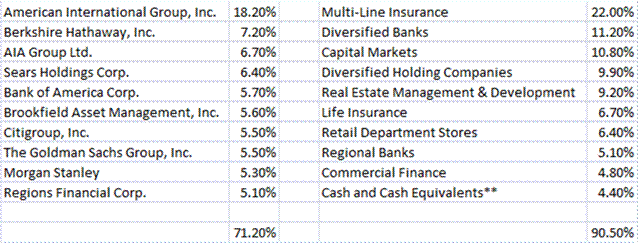
Aside from Sears, all of the top 10 holdings are financials.? And, of those financials that I have some knowledge of, they are all what I would call “complex financials.”
In general, unless you are a heavy hitter, I discourage investment in complex financials because it is hard to tell what you are getting.? Are the assets and liabilities properly stated?? Financial companies are just a gaggle of accruals, and the certainty of having the accounting right on an accrual entry decreases with:
- Company size (the ability of management to make sure values are accurate or conservative declines with size)
- Rapidity of the company’s growth
- Length of the asset or liability
- Uncertainty over when the asset will pay out, or when the liability will require cash
- Uncertainty over how much the asset will pay out, or when how much cash the liability will require
It’s not just a question of whether the assets will eventually be “money good.”? It is also a question of whether the company will have adequate financing to hold those assets in all environments.? For financials, that’s a large part of “margin of safety,” and the main aspect of what failed for many financials in the last five years.
Another aspect of “margin of safety” for financials is whether you are truly “buying it cheap.”? All financial asset values are relative to the financing environment that they are in.? Imagine not only what the assets will be worth if things “normalize,” or conditions continue as at present, but also what they would be worth if liquidity dries up, a la mid-2002, or worse yet, late 2008.
Also remember that financials are regulated, and the regulators tend to react to crises, often making a marginal financial institution do something to clean up at exactly the wrong time, which puts in the bottom for some set of asset classes.? Now, I’m not blaming the regulators (or rating agencies) too much; no one forced the financial company to play near the cliff.? Occasionally, for the protection of the system as a whole, the regulator shoves a financial off the cliff.? (or, a rating agency downgrades them, creating a demand for liquidity because of lending agreements that accelerate on downgrades.)
Finally, think about management quality.? Do they try to grow rapidly?? That’s a danger sign.? There is always the tradeoff between quality, quantity, and price.? In a good environment, you can get 2 out of 3, and in a bad environment, 1 out of 3.? Managements that sacrifice asset quality for growth are not good long run investments, they may occasionally be interesting speculations at the beginning of a new boom phase.
Do they use odd accounting metrics to demonstrate performance?? How much do they explain away one-time events?? Are they raising leverage to boost ROE, or are they trying to improve operations?? Do they try to grow through scale acquisitions?
Are they willing to let bad results show or not?? Even with good financial companies there are disappointments.? With bad ones, the disappointments are papered over until they have to take a “big bath,” which temporarily sets the accounting conservative again.
The above is margin of safety for financials — not just seeming cheapness, but management quality and financing/accounting quality.? They often go together.
Fairholme’s annual report should come out somewhere around the end of January 2012.? What I am interested in seeing is how much of his shareholder base has left given his recent disappointments with AIG, Sears Holdings, Bank of America, Citigroup, Goldman Sachs, Morgan Stanley, Brookfield, and Regions Financial.? Even the others of his top 10 have not done well, and the fund as? a whole has suffered.? Mutual fund shareholders can be patient, but a mutual fund balance sheet is inherently weak for holding assets when underperformance is pronounced.
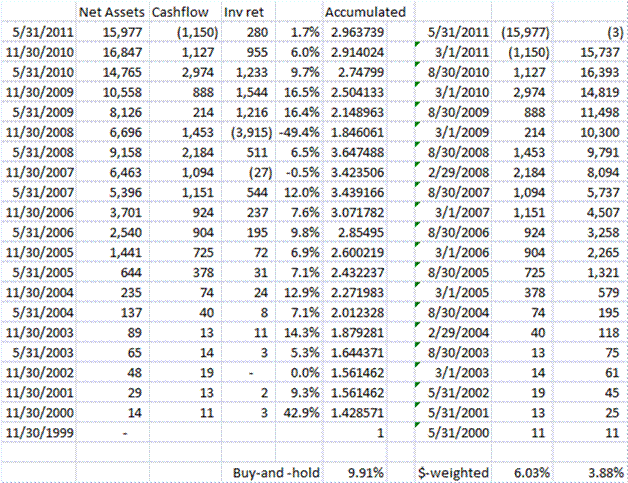
(the above are estimates, I may have made some errors, but the data derives from their SEC filings)
Now, we eat dollar-weighted returns. Only the happy few that bought and held get time-weighted returns.? And, give Fairholme credit on two points (though I suspect it will look worse when the annual report comes out):
- A 9.9% return from inception to 5/31/2011 is hot stuff, and,
- A 6.0% dollar-weighted return is very good as well.? Only losing 3.9% to mutual fund shareholder behavior is not great, but I’ve seen worse.
This is the problem of buying the “hot fund.”? Once a fund becomes the “Ya gotta own this fund” fund, future returns on capital employed get worse because:
- It gets harder to deploy increasingly large amounts of capital, and certainly not as well as in the past.
- Management attention gets divided, because of the desire to start new funds, and the complexity of running a larger organization.
- When relative underperformance does come, it is really hard to right the ship, because assets leave when you can least handle them doing so.? The manager has to think: “Which of my positions that I think are cheap will I liquidate, and what will happen to market prices when it is discovered that I, one of the major holders, is selling?”
That is a tough box to be in, and I sympathize with any manager that finds himself stuck there.? It can be a negative self-reinforcing cycle for some time.? My one bit of advice would be: focus on margin of safety.? If you do, eventually the withdrawals will moderate, and then you can work to rebuild.
One thought on “The Rules, Part XXVII, and, Seeming Cheapness vs Margin of Safety”
Comments are closed.