
I think one of the largest areas for practical investigation in finance is reviewing dollar-weighted versus time weighted returns, especially for vehicles that are traded heavily.? I am going to try to analyze one major ETF per month to see what the level of slippage is due to trading.
But if my hypothesis is wrong, I’ll post on it anyway.? The last post I did on this was on SPY, the S&P 500 Spider.? The slippage was 7%+/year.
Now I have done the calculation for the QQQ, the PowerShares QQQ Trust, which mimics the Nasdaq 100.? The Nasdaq 100 is more volatile than the S&P 500, so I expected the gap to be worse, but it wasn’t: from the inception in March 1999 to the end of the fiscal year in September of 2011, the dollar weighted return was 0.38%/year versus a time-weighted return that a buy-and-hold investor would get of 0.77%/year.? 0.4% of difference isn’t much to talk about.? It still indicates a little bad trading.
That said, the net amount of unit creation and liquidation tended to be small.? Maybe that is the difference.? I have to think more about this, but my advice to anyone using exchange traded products remains the same — read your prospectus carefully, and understand the weaknesses of the vehicle.? If creation units don’t have to be something exact, ask what that might imply for your returns.
Anyway, here were the figures from my dollar-weighted return calculation:
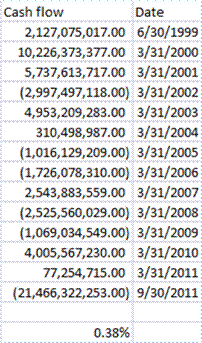 I used annual data, and assumed midperiod dates for the cashflows.
The next ETF I plan to analyze is XLF, the Financial Sector Spider.? I suspect that will look bad, but who knows?
Full disclosure: short SPY in some hedged accounts.
You seem to be mixing up market-timing with flaws in unit creation/liquidation. I know nothing about the latter, but I would be surprised if SPY was actually losing 7%/year to the market-makers who create and liquidate units. That just doesn’t make any sense. But we already know that retail investors are terrible market timers. The real question is who are the good market timers who take the other side of these trades. Hedge funds? David Swensen? Buffett?
You might be right. Both are sources of potential loss, as creation and redemption only occur at times disadvantageous to holders of the ETF.
What puzzles me is that I would have expected losses on the QQQ to be worse, and they aren’t, and I don’t get that.