
After I wrote the piece on momentum, I thought, “Wait a minute.? Momentum and valuation are stronger together than separate — run the calculations and write a new piece.
That’s what led to this article.? I added valuation metrics to the momentum regressions for one month and one year returns and found they were of little value.
Ouch. Not what I expected, so I tried momentum and valuation variables to predict ten-year returns. The results for the regression were significant.
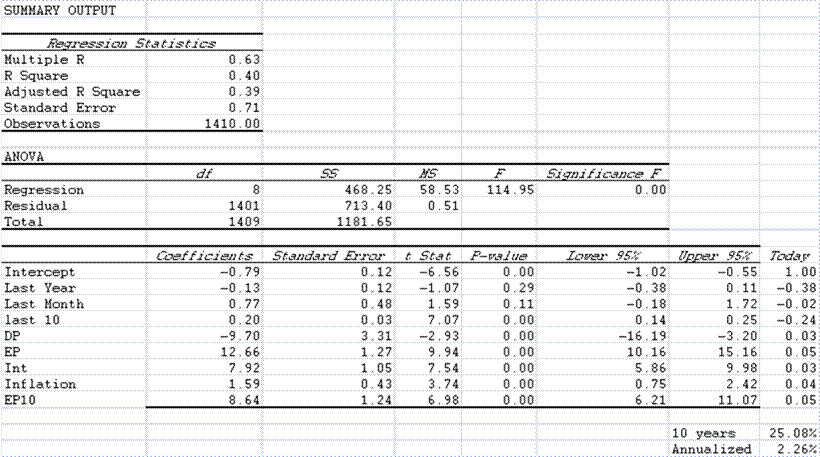
Some definitions:
- Last year: total return over the last year for the S&P 500
- Last month: total return over the last month for the S&P 500
- Last 10: total return over the last 10 years for the S&P 500
- DP: dividend yield
- EP: earnings yield
- Int: 10-year Treasury yield
- Inflation: trailing 12-month inflation from the CPI
- EP10: earnings yield using trailing 10-year earnings.
Trying to forecast ten years into the future, technical variables diminish and fundamental variables show their stuff.? As I have stated before, both current period and long term earnings matter in estimating fair value.? Though I am using Shiller’s data set, it shows that 10-year average earnings are not enough.
That is a big enough finding on its own, but I have something more: using this formula, stocks are expected to earn 2.26%/yr over the next ten years.? After a pathetic decade, do we have another to come?? I(Ask Japan, they have gotten zero over more than 20 years…)
Why might that low return be true?
- Bad momentum begets bad momentum.
- Government bond yields are low offering little competition to stocks.
- Earnings yields still are not high.
Valuations are better than when I wrote the piece, Kiss the Equity Premium Goodbye, but the same problem still exists to a lesser extent.? Where are the projects with high returns on assets that can easily be invested in?? At present, we are not seeing them in bulk.
That is what helps laed me to consider that corporate bonds and bank loans may still be better investments at this point in the cycle — less downside and perhaps a competitive upside.
“That is a big enough finding on its own, but I have something more: using this formula, stocks are expected to earn 2.26%/yr over the next ten years.”
I wonder what model Richard Bernstein is using???
http://runningofthebulls.typepad.com/toros_running_of_the_bull/2008/12/expect-triple-digit-returns-over-the-next-decade.html
Expect Triple Digit Returns Over the Next Decade
According to Merrill Lynch strategist Richard Bernstein, since the 1930s, whenever the return from stocks has been negative over 10 years, equities rose by at least 100% over the following 10.
There have been 30 times since the 1930s when the trailing 10-year return on stocks was negative. The compounded average return per year after the negative decade has been 12%, higher than the long-term average of ~10%.
Why does dividend yield have a negative coefficient?
Hello,
How might a retail investor access good quality bank loans?
I’ve found numerous closed end funds that specialize in bank loans for BB and under, but nothing investment grade.
Thanks in adavance,
-Tom
David,
By far the most important factors in your analysis are the poor performances for the S&P over the last 10 years and 1 year. Your regression calculates that the poor performance over those two time frames results in expected returns over the next 10 years being cut by more than half.
More broadly, I note that your technical factors are all negative while your fundamental factors are all positive.
To all — don’t get me wrong here… this is just one model. Don’t trust just one model.
Mike — Richard Bernstein is a bright guy, and one of the best practical economists on the Street. Thanks for the link. But Shiller’s dataset goes back to 1871, and contains the little bit of fundamental data that I used here.
Doug — as to exactly why dividends are a negative factor (and statistically significantly different from zero), I’m not sure. If I didn’t have the two earnings variables, inflation and interest rates there, I’m sure it would be positive.
Tom — I would use the closed-end funds that invest in bank debt of junk rated companies. The investment grade stuff almost never makes it into the hands of the public. It stays with the banks.
Ted — I noticed the fundamental versus technical split as well, but didn’t comment on it. The technical factors are kind of hinky — who would expect a significant positive correlation between the prior ten years and the next ten? The other two aren’t significant, but last month is positive, and last year negative?
To all again — I came into this one with no agenda, wondering what I would find. I ran the regression once using all the factors at my disposal; I did not optimize the calculation. The size of the R-squared was a positive surprise, as were most of the t-coefficients. And, yes, the sign on the dividend yield as an independent factor surprised me as well.
The 2.26% seems bearish to me, but that what the model put out; now we need to consider what it means, and whether it might be wrong.
Wow. That would not be good news. We’re starting to merge here with another of your other key themes, the Looming Pension Crisis. If the principles of the the Pain Trade hold true, that 2.26% return will come with gut-churning volatility and could be further eaten away by transaction costs, depending on your investment horizon.
But as we attempt usher the largest demographic swell our nation has ever known into its retirement, I suppose it’s natural we’ll observe some model-busting anomalies.
Looking forward to the results as you noodle this through…….
Is the forecast return real or nominal? (I presume nominal since inflation is an input, but just wanted to check.) Thx
Ben — Nominal.
This is getting really scary! I think I will follow your advice and sell.
GMO’s last asset class forecasts were pretty bullish on stocks:
http://seekingalpha.com/article/106905-grantham-expect-12-annual-return-from-quality-u-s-equities-actively-managed
Maybe you’re both right, and we’re just in for another crash eight or so years out…
i think the reason that dp has a negative coefficient could be a high correlation between it and ep (which you would expect). if so, ep is ‘taking credit’ for the effect of dp, and has a too highly positive coefficient.
we blew 2 major bubbles in the last 10 yrs, and in real dollars are flat, in inflation adjusted dollars are strongly negative.
we had ZERO real GDP growth over last decade.
Now, someone please step up and explain why our stock market should grow significantly, current depression aside?
The answer is , there is no reason. Select companies involved with china and indias growth will have tremendous success though.
Anyone simply parroting statistics from other time periods is a fool. There are too many variables to be considered that arent.
What happens if you add in the 3-month Treasury yield?
I suggest the 3-month might send a significantly different message than the 10-year, for two reasons. One reason is empirical, the other theoretical.
The empirical reason to use 3-month yields: Pu Shen at the Federal Reserve showed in 2001 that the spread between earnings yield and 3-month Treasuries was significantly predictive of stock market performance — and that the spread with 3-month Treasuries was more predictive than the spread with 10-year Treasuries. (Pu Shen’s paper is online: http://www.kc.frb.org/Publicat/Reswkpap/PDF/RWP02-01.pdf)
The theoretical underpinning: the 3-month Treasury is distinctively the “flight to liquidity” security, and thus can be a better measure of the ratio of fear versus greed in the market than the less liquid 10-year Treasury.
If you add the 3-month Treasury yield into the regression, what changes?
Grantham is assuming that the financing difficulties go away, and is assuming that profits recover in my opinion. My model uses 1-year and 10-year trailing earnings. (note to Shiller fans — the 1-year earnings have a larger impact).
Regarding the 3-month treasury yield , the series doesn’t go back that far. 12-month inflation is probably a good proxy.
In reference to Richard Bernstein’s observations, has anyone looked at negative 10 year periods on a real-return basis as opposed to nominal? That would expand the data set.